Campylobacter is the most common cause of bacterial food poisoning in the UK, and raw poultry is its main source. It rarely grows in food, but a small number of cells can be enough to cause illness, so the risk lies in cross-contamination: from raw poultry to equipment, surfaces, packaging, hands and other foods.
UV-C disinfection offers an additional, chemical-free layer of control. It inactivates Campylobacter by damaging its DNA, acts within seconds to minutes, leaves no residue, and the dose delivered can be measured and recorded to support your food safety plan.
This guide explains where Campylobacter spreads in poultry and food processing facilities, what the published research says about the UV-C dose needed to inactivate it, and how UV-C systems can support control. It is written for factory managers, food safety and quality managers, and hygiene and compliance teams in food production, and for catering managers in healthcare.
Campylobacter at a glance
| Type | Bacterium (vegetative, non-spore forming) |
| Where it grows | Warm conditions only, so it does not usually multiply in chilled food |
| UV-C wavelength used | 254 nm |
| Published 3-log dose (99.9%) | 18 J/m² (1.8 mJ/cm²) for Campylobacter jejuni in laboratory suspension (Butler 1987) |
| Compared with E. coli in the same study | E. coli needed 50 J/m² for the same 3-log reduction, so C. jejuni was around 2.8 times more sensitive |
| Dose data in real food conditions | Higher doses are likely in practice, particularly where poultry juices or soiling are present |
What is Campylobacter?
Campylobacter is a group of bacteria that live in the intestines of birds and animals, particularly poultry, and are found in raw poultry meat, raw milk and untreated water. Campylobacter jejuni is the species most commonly associated with human illness.
It causes campylobacteriosis, which typically brings diarrhoea, stomach cramps and fever. Most people recover, but it can be serious for young children, older people and anyone with a weakened immune system, and it is occasionally followed by complications such as Guillain-Barré syndrome.
Why Campylobacter is a problem in food production
It is very common in raw poultry. A high proportion of raw chicken carries Campylobacter, so it enters poultry processing and food handling facilities as a matter of routine.
It has a low infectious dose. A few hundred cells, or fewer, can be enough to cause illness, so even very low levels of contamination on a surface or utensil matter.
It spreads by cross-contamination. Because it does not grow well outside a warm host, the main risk is transfer from raw poultry and its juices to equipment, boards, knives, hands, packaging and ready-to-eat foods.
It is not controlled by chilling alone. Campylobacter does not usually multiply at chill temperatures, but it can survive in chilled and frozen products, so refrigeration does not remove the risk.
Cooking thoroughly kills Campylobacter, so the risks arise where raw and cooked products or surfaces come into contact, and where food is eaten without further cooking.
Campylobacter in healthcare and care settings
Hospitals, care homes and other healthcare settings serve poultry to people who are more vulnerable to serious illness. Catering areas need careful separation of raw and cooked products, and control of the boards, utensils, equipment and preparation surfaces that handle raw poultry. UV-C can add a further control for catering equipment, utensils and exposed surfaces.
Where Campylobacter spreads: typical hot spots
Poultry reception and handling areas, including crates, trays and transport containers that arrive with raw product.
Processing and cutting areas, where equipment, conveyors and shackles come into contact with raw poultry and its juices.
Knives, boards and utensils used for raw poultry, which can carry Campylobacter to other products.
Poultry juices and drip on food contact surfaces, conveyors, trays and packaging, which can spread contamination and shield bacteria from cleaning.
Wet areas, including drains, floors and splash zones, where contamination can spread through water and aerosols.
Packing and wrapping lines, where raw products are packed and the risk of cross-contamination to packaging and surrounding areas is highest.
Raw and ready-to-eat boundaries, where staff, trolleys, utensils and equipment can move contamination between zones.
Handwash stations and shared touch points.
Catering kitchens in healthcare and care settings, where raw poultry is prepared alongside ready-to-eat foods.
Cleaning and segregation are the foundation of Campylobacter control. UV-C adds a measurable, chemical-free step on top of them, particularly for equipment and surfaces that move between raw and cooked areas.
How UV-C inactivates Campylobacter
UV-C light at around 254 nm is absorbed by the DNA of Campylobacter. The energy damages the genetic material so the bacterium can no longer replicate or cause infection. Because the mechanism is physical rather than chemical, it leaves no residue and does not depend on chemical contact time.
UV-C dose requirements for Campylobacter
Campylobacter is not included in the standard dose table on our microorganisms page, which lists D90 values. The best-known published figure is from a laboratory study of Campylobacter jejuni at 254 nm (Butler et al., 1987), which reported the dose needed for a 3-log (99.9%) reduction.
| Organism | 3-log dose (99.9%) | In J/m² |
|---|---|---|
| Campylobacter jejuni | 1.8 mJ/cm² | 18 J/m² |
| Escherichia coli (same study) | 5.0 mJ/cm² | 50 J/m² |
Dose is irradiance (W/m²) multiplied by exposure time (seconds). At illustrative irradiance levels, a dose of 18 J/m² would take roughly 4 seconds at 5 W/m², 2 seconds at 10 W/m² and 1 second at 20 W/m². These are theoretical figures that assume a constant irradiance.
How should this figure be read?
It comes from a controlled laboratory study. The bacteria were suspended in a thin liquid layer and exposed to a collimated beam of UV-C, which is very different from bacteria on a food contact surface or in poultry juices. Real conditions generally need more dose. A separate study reported a reduction of more than 5-log for Campylobacter jejuni in poultry exudate on food contact surfaces (Sommers and Gunther, 2013), which suggests UV-C is effective on contaminated surfaces, but the dose needed in practice depends on the soiling present and the conditions.
Bacterial inactivation curves are also not always a straight line, so we have not extended this single figure into a table of higher log reductions the way we have for other organisms.
How does Campylobacter compare with other organisms?
In the same study, Campylobacter jejuni was inactivated at a lower dose than E. coli, so it appears more sensitive to UV-C. Our other organism guides show that Listeria monocytogenes needs a considerably higher dose than E. coli, Salmonella and Staphylococcus aureus.
Because the studies use different methods and conditions, direct comparison between different studies is not like-for-like. Where you need to control several pathogens, design around the one with the highest dose requirement. A system designed for Listeria is likely to give a good margin for Campylobacter. See our guides to Listeria monocytogenes, Salmonella, E. coli and Staphylococcus aureus.
The published data we have does not give a dose for Campylobacter in air. If air disinfection is part of your plan, we will discuss how it should be assessed.
Why the dose in your facility differs
In a working facility, the dose that reaches Campylobacter depends on distance from the lamp, exposure time, lamp output and age, shadowing, and surface condition. Poultry juices, fat, blood and other residues are a particular issue because they can shield bacteria from UV-C. Surfaces should be cleaned first.
We size systems around your process and measure the result. Our UV meters for process monitoring help you confirm that the intended dose is reaching the target and keep a record for audit purposes. Where a specific reduction is required, testing in your own conditions is the most reliable way to prove it.
UV-C solutions for Campylobacter control
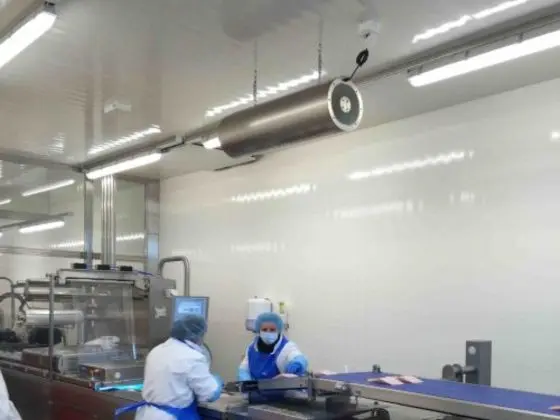
UV air disinfection
Reduce airborne contamination to keep air clean.
Browse air disinfection solutions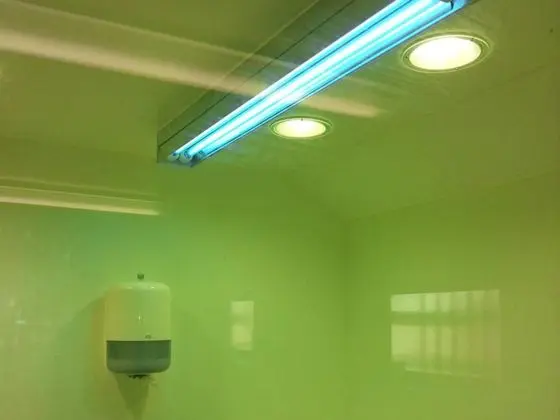
UV surface disinfection
Kill bacteria and viruses on surfaces to improve cleanliness.
Browse surface disinfection lamps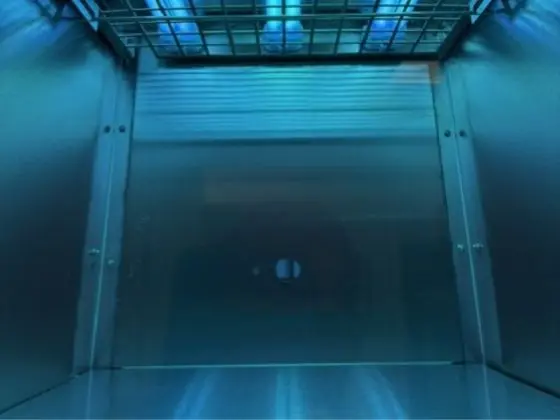
Enclosed UV disinfection
Safe and effective disinfection of items, tools and utensils.
Browse enclosed systemsWhat UV-C can and cannot do for Campylobacter
UV-C is a valuable additional control, and it works best when its limits are understood.
UV-C is line of sight. It only inactivates Campylobacter it reaches, so shadowed, rough or hidden areas may not receive the required dose.
It works best on clean surfaces. Poultry juices, fat and soil can shield microorganisms, so UV-C does not replace cleaning.
It supports, but does not replace, your wider controls, including segregation of raw and cooked areas, cleaning, hand hygiene, temperature control and cooking.
It must be validated. Where a specific reduction is needed, performance should be confirmed under representative conditions.
Direct treatment of raw poultry, carcasses and other food products with UV-C is subject to specific regulatory requirements, so we focus on equipment, surfaces, packaging, tools and air. If you are considering any treatment of food itself, we recommend taking regulatory advice first.
Implementing UV-C safely
UV-C can damage eyes and skin, and must never be used to disinfect people, hands or skin. Any installation needs a proper assessment of exposure risk, engineering controls, guarding and interlocks, operating procedures and training, including during cleaning and maintenance.
We support organisations with a UV safety and compliance package, UV risk management training, workplace radiation surveys and hazard awareness training. We also run a free UV safety webinar covering the legal requirements for artificial UV sources in the workplace.
Frequently asked questions
Does UV-C kill Campylobacter?
Yes. UV-C light at around 254 nm damages the DNA of Campylobacter, preventing it from replicating. A laboratory study found that a dose of 18 J/m² gave a 3-log (99.9%) reduction of Campylobacter jejuni.
What UV-C dose is needed for Campylobacter?
The published laboratory figure for a 3-log (99.9%) reduction of Campylobacter jejuni is 18 J/m² (1.8 mJ/cm²). Real-world conditions, particularly poultry juices and soiling on surfaces, can increase the dose needed, so performance should be validated for your process.
Is Campylobacter easier to kill with UV-C than E. coli?
In the laboratory study that tested both, Campylobacter jejuni needed 18 J/m² for a 3-log reduction, compared with 50 J/m² for E. coli, so it appeared around 2.8 times more sensitive.
Does UV-C work on poultry juices and raw chicken surfaces?
Research has reported more than a 5-log reduction of Campylobacter jejuni in poultry exudate on food contact surfaces using UV-C. However, juices, fat and soil can shield bacteria, so surfaces should be cleaned first and performance validated.
Can UV-C be used to treat raw poultry?
Direct treatment of raw poultry and other food with UV-C is subject to specific regulatory requirements. We focus on equipment, surfaces, packaging, tools and air, and recommend taking regulatory advice before considering any treatment of food itself.
Why is Campylobacter hard to control if it does not grow in food?
Because it has a low infectious dose, even small numbers transferred by cross-contamination can cause illness. Control therefore depends on preventing raw poultry and its juices from contaminating equipment, surfaces and other foods.
Can UV-C replace cleaning?
No. UV-C cannot remove soiling and only works where light reaches. It adds a measurable, chemical-free step on top of cleaning and can reduce reliance on chemical sanitisers in some applications.
Related microorganisms
Campylobacter is one of several organisms that UV-C can help control. See our guides to Listeria monocytogenes, Salmonella, E. coli and Staphylococcus aureus, or return to the full list of microorganisms inactivated by UV-C, with D90 dose data for more than 90 bacteria, viruses and spores.
Talk to our UV-C specialists about Campylobacter control
Tell us about your facility, your products and where Campylobacter is a risk, and we will help you work out the dose you need and the right UV-C system to deliver it. We can arrange an online or onsite consultation.
Call us on +44 (0) 1564 200 826 or contact us to request a quotation.