Salmonella is one of the most common causes of foodborne illness and one of the most challenging bacteria for food manufacturers to control. It is associated with raw poultry, eggs and meat, but it is also a major concern in dry, low-moisture foods such as chocolate, flour, nuts, spices, powders and pet food, where it can survive on dry surfaces and in dust for long periods.
UV-C disinfection offers an additional, chemical-free layer of control. It inactivates Salmonella by damaging its DNA, acts within seconds to minutes, leaves no residue, and is a dry method. That makes it particularly valuable where adding water or chemicals is a risk. The dose delivered can also be measured and recorded to support your food safety plan.
This guide explains where Salmonella persists in a facility, what dose of UV-C the published research says is needed to inactivate it, and how air, surface and enclosed UV-C systems can support control. It is written for factory managers, food safety and quality managers, and hygiene and compliance teams in food production, and for catering and infection control teams in healthcare.
Salmonella at a glance
| Type | Bacterium (vegetative, non-spore forming) |
| UV-C wavelength used | 254 nm |
| D90 dose (1-log, 90% reduction) | 10 J/m² for Salmonella enteritidis on surfaces (Collins 1971) |
| Other published value | 21 J/m² for Salmonella typhi on surfaces (Sharp 1939) |
| Illustrative 3-log dose (99.9%) | 30 J/m² for S. enteritidis |
| Compared with other food pathogens | Much lower than Listeria monocytogenes (156 J/m²), Staphylococcus aureus (66 J/m²) and E. coli (55 J/m²) |
What is Salmonella?
Salmonella is a group of bacteria that live in the intestines of animals, especially poultry, pigs and cattle, and in the environment. It causes salmonellosis, which typically brings diarrhoea, fever and stomach cramps. It is usually self-limiting in healthy adults, but can be serious for young children, older people and anyone with a weakened immune system.
Salmonella enteritidis and Salmonella typhimurium are among the types most commonly linked to foodborne illness, while Salmonella typhi causes typhoid fever.
Why Salmonella is a problem in food production
Salmonella is hard to control for several reasons.
It is widespread in raw materials. Poultry, eggs, meat and some plant-based ingredients can bring it into a facility, so the risk is present from the moment goods are delivered.
It survives in dry conditions. Unlike many bacteria, Salmonella can survive for extended periods in low-moisture environments and foods. It may not grow in a dry product, but small numbers can still be enough to cause illness.
It spreads by cross-contamination. Surfaces, equipment, trolleys, hands and dust can move Salmonella from raw materials and dirty areas to finished products. Research has shown that Salmonella can persist on dry stainless steel for days and transfer to food on contact.
Moisture can trigger growth. In dry processing environments, leaks, condensation or wet cleaning can introduce moisture that allows dormant Salmonella to grow and spread. For this reason, wet cleaning in dry areas is generally kept to a minimum.
UK and EU food law sets microbiological criteria for Salmonella in a range of foods, and a positive result can lead to withdrawal, recall and a loss of customer confidence.
Salmonella in healthcare and care settings
Hospitals and care homes serve food to older people and others who are more vulnerable to severe illness. Catering equipment, utensils, preparation surfaces and chilled storage need careful control, particularly for raw eggs, poultry and meat, where cross-contamination is a risk. UV-C can add a further control for equipment, utensils and exposed surfaces in catering areas.
Where Salmonella persists: typical hot spots
Raw material and goods-in areas, including poultry, egg and meat handling, and the packaging, pallets and crates that arrive with them.
Raw and ready-to-eat boundaries, where staff, trolleys, utensils and equipment can carry contamination from one zone to another.
Dry processing lines in the production of chocolate, flour, nuts, spices, powders and pet food, including conveyors, hoppers, mixers and filling equipment.
Dust and residues on equipment, structural supports, framing, ledges and overhead surfaces, which can harbour Salmonella and shield it from cleaning.
Dry stainless steel surfaces, where it can survive and transfer to products on contact.
Knives, slicers, boards and utensils used in raw and cooked product areas.
Packing areas, where products are exposed before sealing.
Damp spots in otherwise dry areas, such as leaks, condensation, floor drains and areas near wet cleaning, where growth can occur.
Cleaning is the foundation of Salmonella control. UV-C adds a measurable, chemical-free step on top of it, particularly in dry areas and for equipment that moves between zones.
How UV-C inactivates Salmonella
UV-C light at around 254 nm is absorbed by the DNA of Salmonella. The energy damages the genetic material so the bacterium can no longer replicate or cause infection. Because the mechanism is physical rather than chemical, it leaves no residue, adds no moisture and does not depend on chemical contact time.
UV-C dose requirements for Salmonella
Dose (J/m²) is the irradiance reaching the target (W/m²) multiplied by the exposure time (seconds). The published D90 for Salmonella enteritidis on surfaces is 10 J/m², a 90% reduction. This is one of the lowest values among the food pathogens in our dataset, so Salmonella is highly sensitive to UV-C.
Each further log reduction needs another D90 of dose. The table below shows the dose for each level of reduction for Salmonella enteritidis, and how long this would take at three illustrative irradiance levels.
| Log reduction | Reduction | Dose (J/m²) | Time at 5 W/m² | Time at 10 W/m² | Time at 20 W/m² |
|---|---|---|---|---|---|
| 1-log | 90% | 10 | 2 seconds | 1 second | 0.5 seconds |
| 2-log | 99% | 20 | 4 seconds | 2 seconds | 1 second |
| 3-log | 99.9% | 30 | 6 seconds | 3 seconds | 1.5 seconds |
| 4-log | 99.99% | 40 | 8 seconds | 4 seconds | 2 seconds |
| 5-log | 99.999% | 50 | 10 seconds | 5 seconds | 2.5 seconds |
| 6-log | 99.9999% | 60 | 12 seconds | 6 seconds | 3 seconds |
These are theoretical figures that assume a constant irradiance and a straight-line response. They show how dose, irradiance and time relate, not a guarantee of performance in a real installation.
For Salmonella typhi, the published D90 is 21 J/m² on surfaces, so the same reductions need roughly double the doses above.
How does Salmonella compare with other organisms?
Salmonella enteritidis is far more sensitive to UV-C than most other food pathogens. Its D90 of 10 J/m² is around 5 times lower than E. coli (55 J/m²) and around 15 times lower than Listeria monocytogenes (156 J/m²).
This has a practical consequence. A system sized only for Salmonella may not deliver enough dose for more resistant organisms. Where you need to control several pathogens, design around the one with the highest dose requirement. See our guides to Listeria monocytogenes and E. coli.
Dose requirements for Salmonella in air are not given in the published dataset we use. If air disinfection is part of your plan, we will discuss how it should be assessed.
Why the dose in your facility differs
Published values come from controlled laboratory tests. In a working facility, the dose that reaches Salmonella depends on distance from the lamp, exposure time, lamp output and age, shadowing, and surface condition.
Dust is a particular issue in dry environments. A layer of dust or residue can shield Salmonella from UV-C, so surfaces should be cleaned first, ideally using dry methods in dry areas. We size systems around your process and measure the result, and our UV meters for process monitoring help you confirm that the intended dose is reaching the target.
UV-C solutions for Salmonella control
We supply UV-C systems for the main routes by which Salmonella spreads in a facility.
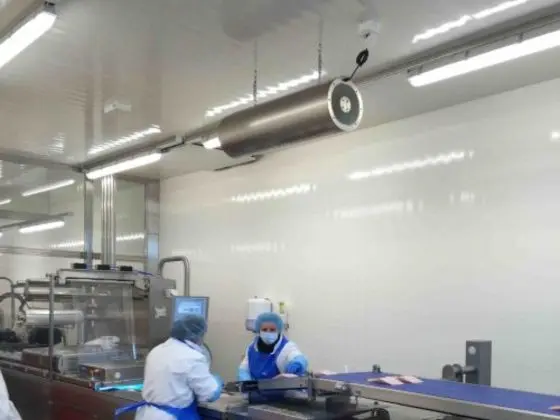
UV air disinfection
Reduce airborne contamination to keep air clean.
Browse air disinfection solutions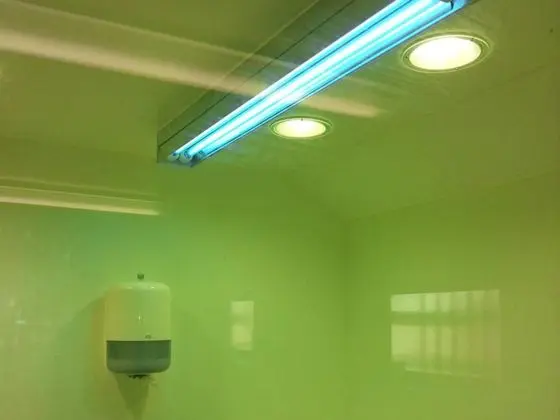
UV surface disinfection
Kill bacteria and viruses on surfaces to improve cleanliness.
Browse surface disinfection lamps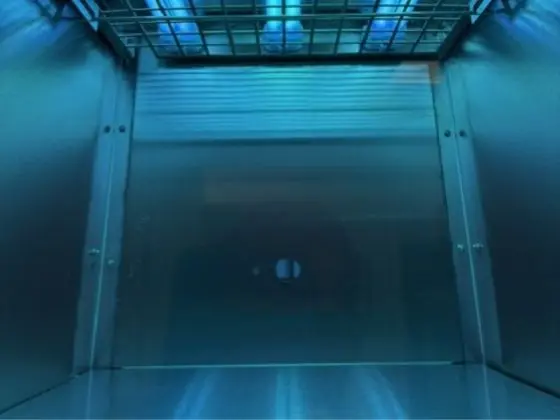
Enclosed UV disinfection
Safe and effective disinfection of items, tools and utensils.
Browse enclosed systemsWhat UV-C can and cannot do for Salmonella
UV-C is a valuable additional control, and it works best when its limits are understood.
UV-C is line of sight. It only inactivates Salmonella it reaches, so shadowed, rough or hidden areas may not receive the required dose.
It works best on clean surfaces. Dust, residues and films can shield microorganisms, so UV-C does not replace cleaning.
It supports, but does not replace, your wider controls, including supplier controls, zoning, cleaning, pest control and environmental monitoring.
It must be validated. Where a specific reduction is needed, performance should be confirmed under representative conditions, ideally alongside your environmental monitoring results.
Direct treatment of food products, including raw poultry and eggs, with UV-C is subject to specific regulatory requirements, so we focus on equipment, surfaces, packaging, tools and air. If you are considering any treatment of food itself, we recommend taking regulatory advice first.
Implementing UV-C safely
UV-C can damage eyes and skin, and must never be used to disinfect people, hands or skin. Any installation needs a proper assessment of exposure risk, engineering controls, guarding and interlocks, operating procedures and training, including during cleaning and maintenance.
We support food producers with a UV safety and compliance package, UV risk management training, workplace radiation surveys and hazard awareness training. We also run a free UV safety webinar covering the legal requirements for artificial UV sources in the workplace.
Frequently asked questions
Does UV-C kill Salmonella?
Yes. UV-C light at around 254 nm damages the DNA of Salmonella, preventing it from replicating. The published D90 is 10 J/m² for Salmonella enteritidis and 21 J/m² for Salmonella typhi on surfaces.
What UV-C dose is needed for Salmonella?
For Salmonella enteritidis on surfaces, the D90 is 10 J/m², so a 3-log (99.9%) reduction needs roughly 30 J/m² and a 4-log (99.99%) reduction roughly 40 J/m². These are indicative laboratory figures, and the dose needed in practice should be validated for your process.
How long does it take UV-C to kill Salmonella?
It depends on the irradiance reaching the target. Dose equals irradiance multiplied by time, so at 10 W/m² a 3-log reduction needs around 3 seconds. Distance, lamp output and surface condition affect the irradiance in your facility, so real exposure times are normally set by validation.
Is Salmonella easier to kill with UV-C than Listeria?
Yes. Its published D90 of 10 J/m² is around 15 times lower than that of Listeria monocytogenes (156 J/m²). A system designed for Listeria will normally also cover Salmonella, but the reverse is not true.
Can UV-C be used in dry or low-moisture facilities?
Yes. UV-C is a dry method, so it adds no moisture. This is useful in dry processing areas, where moisture can allow Salmonella to grow and wet cleaning is generally restricted. Surfaces should be cleaned first, as dust and residue can shield Salmonella from the light.
Can UV-C replace cleaning?
No. UV-C cannot remove soiling and only works where light reaches. It adds a measurable, chemical-free step on top of cleaning and can reduce reliance on chemical sanitisers in some applications.
Related microorganisms
Salmonella is one of several organisms that UV-C can help control. See our guides to Listeria monocytogenes and E. coli, or return to the full list of microorganisms inactivated by UV-C, with D90 dose data for more than 90 bacteria, viruses and spores.
Talk to our UV-C specialists about Salmonella control
Tell us about your facility, your products and where Salmonella is a risk, and we will help you work out the dose you need and the right UV-C system to deliver it. We can arrange an online or onsite consultation.
Call us on +44 (0) 1564 200 826 or contact us to request a quotation.