Escherichia coli (E. coli) is both an everyday hygiene indicator and a serious pathogen. Most strains are harmless, but Shiga toxin-producing strains such as E. coli O157:H7 can cause severe illness from a very small number of cells. For food producers, one contamination event can mean recalls, outbreak investigations and lasting damage to your brand. For healthcare providers, E. coli is a common cause of healthcare-associated infections.
UV-C disinfection offers an additional, chemical-free layer of control. It inactivates E. coli by damaging its DNA, acts within seconds to minutes, leaves no residue, and the dose delivered can be measured and recorded to support your hygiene and food safety plans.
This guide explains where E. coli spreads in food and healthcare facilities, what dose of UV-C the published research says is needed to inactivate it in air and on surfaces, and how UV-C systems can support control. It is written for factory managers, food safety and quality managers, infection control directors and hygiene and compliance teams.
E. coli at a glance
| Type | Bacterium (vegetative, non-spore forming) |
| UV-C wavelength used | 254 nm |
| D90 dose on surfaces (1-log, 90% reduction) | 55 J/m² (Hollaender 1955) |
| D90 dose in air | 11 J/m² (Koller 1939) |
| Illustrative 3-log dose (99.9%) | 165 J/m² on surfaces, 33 J/m² in air |
| Compared with other food pathogens | Higher than Salmonella enteritidis (10 J/m²) and lower than Listeria monocytogenes (156 J/m²) |
What is E. coli?
E. coli is a bacterium that lives in the intestines of humans and animals. Most strains are harmless and are a normal part of gut bacteria. Others cause illness, including strains that produce Shiga toxin (STEC), of which E. coli O157:H7 is the best known.
STEC infections can cause severe stomach cramps and bloody diarrhoea, and in some people, particularly young children, can lead to haemolytic uraemic syndrome (HUS), a serious condition affecting the kidneys. Other types of E. coli are a leading cause of urinary tract infections and can cause bloodstream infections in healthcare settings.
Why E. coli is a problem in food production
It has a very low infectious dose. For STEC, fewer than 100 cells can be enough to cause illness, so even low levels of contamination matter, particularly in foods eaten raw or lightly cooked.
It comes from animals. Cattle, sheep and goats are the main reservoirs of STEC. Contamination can reach meat during slaughter and processing, and reach fresh produce, flour and dairy through manure, water and cross-contamination.
It spreads in many types of food. Beef, particularly ground beef, and leafy greens are the most common sources of outbreaks, but E. coli has also been linked to raw milk, flour, sprouts and other products.
It is a hygiene indicator. Even where it is not a harmful strain, generic E. coli is widely used to assess hygiene, and its presence on equipment, surfaces or products points to a gap in cleaning or process control.
It survives in cold and acidic conditions, so refrigeration and acidity alone are not always enough to control it.
E. coli in healthcare
In hospitals, care homes and other healthcare settings, E. coli is associated with healthcare-associated infections, including urinary tract and bloodstream infections, and some strains are resistant to antibiotics. It can spread via contaminated surfaces, shared equipment and hands. Antibiotic resistance does not change how UV-C works, because UV-C acts on the organism’s DNA. UV-C can therefore add a further control for surfaces, equipment and air in suitable areas, alongside cleaning and hand hygiene.
Where E. coli spreads: typical hot spots
Raw meat areas, where contamination can transfer from hides and carcasses to equipment and surfaces.
Grinders, mincers, slicers, knives and boards that handle raw meat and can carry E. coli to other products.
Produce handling lines, including conveyors, cutting equipment and packing areas for leafy greens and other produce eaten raw.
Flour and dry ingredient handling, where raw flour has been linked to outbreaks.
Raw and ready-to-eat boundaries, where staff, trolleys, utensils and equipment can carry contamination between zones.
Drains, wet floors and standing water, where E. coli can persist and spread by splashing and aerosols.
Packing and wrapping areas, where products are exposed before sealing.
Shared touch points and equipment, including handles, controls, trolleys and PPE stations.
In healthcare: kitchens and catering areas, clinical equipment, shared surfaces and washrooms.
Cleaning is the foundation of E. coli control. UV-C adds a measurable, chemical-free step on top of it.
How UV-C inactivates E. coli
UV-C light at around 254 nm is absorbed by the DNA of E. coli. The energy damages the genetic material so the bacterium can no longer replicate or cause infection. Because the mechanism is physical rather than chemical, it leaves no residue, and it works regardless of whether a strain is resistant to antibiotics.
UV-C dose requirements for E. coli
Dose (J/m²) is the irradiance reaching the target (W/m²) multiplied by the exposure time (seconds). The published D90 for E. coli is 55 J/m² on surfaces, and 11 J/m² in air. This is the dose needed to inactivate 90% of the population, a 1-log reduction.
Each further log reduction needs another D90 of dose. The table below shows the dose for each level of reduction on surfaces, and how long this would take at three illustrative irradiance levels.
| Log reduction | Reduction | Dose on surfaces (J/m²) | Time at 5 W/m² | Time at 10 W/m² | Time at 20 W/m² |
|---|---|---|---|---|---|
| 1-log | 90% | 55 | 11 seconds | 6 seconds | 3 seconds |
| 2-log | 99% | 110 | 22 seconds | 11 seconds | 6 seconds |
| 3-log | 99.9% | 165 | 33 seconds | 17 seconds | 8 seconds |
| 4-log | 99.99% | 220 | 44 seconds | 22 seconds | 11 seconds |
| 5-log | 99.999% | 275 | 55 seconds | 28 seconds | 14 seconds |
| 6-log | 99.9999% | 330 | 66 seconds | 33 seconds | 17 seconds |
For air, the D90 of 11 J/m² means a 3-log reduction needs around 33 J/m², and a 4-log reduction around 44 J/m².
These are theoretical figures that assume a constant irradiance and a straight-line response. They show how dose, irradiance and time relate, not a guarantee of performance in a real installation.
Why are the surface and air values different?
The published figures come from different studies, using different methods and conditions, and microorganisms on surfaces can be affected by factors such as the surface material, drying and soiling. In practice, the dose a surface needs is usually higher than for airborne organisms, so surface systems should be designed around the surface value.
How does E. coli compare with other organisms?
E. coli sits in the middle of the common food pathogens. Its surface D90 of 55 J/m² is around 5 times higher than Salmonella enteritidis (10 J/m²) and around 3 times lower than Listeria monocytogenes (156 J/m²).
Where you need to control several pathogens, design around the one with the highest dose requirement. A system sized for Listeria will usually also cover E. coli and Salmonella. See our guides to Listeria monocytogenes and Salmonella.
A note on strains
Published dose data for E. coli comes from laboratory studies, often using non-pathogenic strains, and different strains, including pathogenic STEC types, can respond differently. For this reason we recommend validating performance for your own application.
Why the dose in your facility differs
In a working facility, the dose that reaches E. coli depends on distance from the lamp, exposure time, lamp output and age, shadowing, surface condition, soiling and moisture. Operating temperature also matters, because UV-C lamp output is affected by temperature, which is important in chilled meat and produce areas.
We size systems around your process and measure the result. Our UV meters for process monitoring help you confirm that the intended dose is reaching the target and keep a record for audit purposes.
UV-C solutions for E. coli control
We supply UV-C systems for the main routes by which E. coli spreads in food and healthcare facilities.
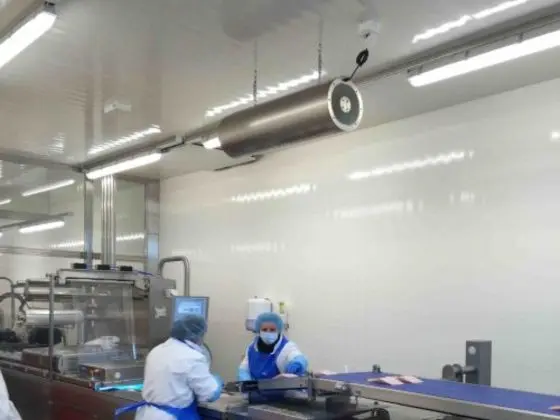
UV air disinfection
Reduce airborne contamination to keep air clean.
Browse air disinfection solutions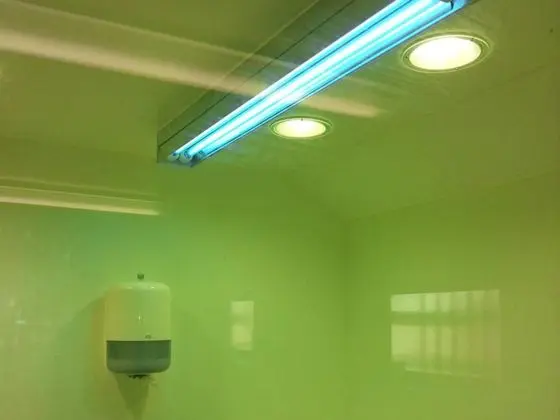
UV surface disinfection
Kill bacteria and viruses on surfaces to improve cleanliness.
Browse surface disinfection lamps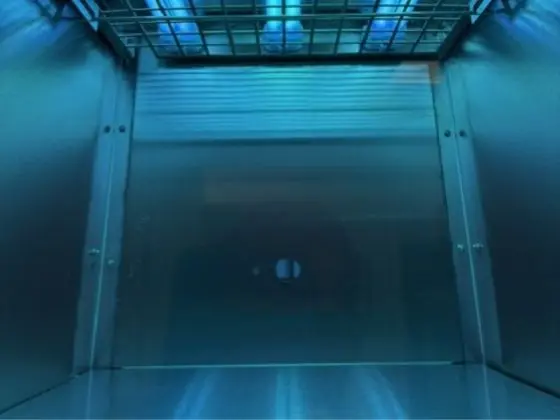
Enclosed UV disinfection
Safe and effective disinfection of items, tools and utensils.
Browse enclosed systemsWhat UV-C can and cannot do for E. coli
UV-C is a valuable additional control, and it works best when its limits are understood.
UV-C is line of sight. It only inactivates E. coli it reaches, so shadowed, rough or hidden areas may not receive the required dose.
It works best on clean surfaces. Blood, fat, soil and films can shield microorganisms, so UV-C does not replace cleaning.
It supports, but does not replace, your wider controls, including supplier controls, hygiene, temperature control, cooking and environmental monitoring.
It must be validated. Where a specific reduction is needed, performance should be confirmed under representative conditions.
Direct treatment of food products, including meat and fresh produce, with UV-C is subject to specific regulatory requirements, so we focus on equipment, surfaces, packaging, tools and air. If you are considering any treatment of food itself, we recommend taking regulatory advice first.
Implementing UV-C safely
UV-C can damage eyes and skin, and must never be used to disinfect people, hands or skin. Any installation needs a proper assessment of exposure risk, engineering controls, guarding and interlocks, operating procedures and training, including during cleaning and maintenance.
We support organisations with a UV safety and compliance package, UV risk management training, workplace radiation surveys and hazard awareness training. We also run a free UV safety webinar covering the legal requirements for artificial UV sources in the workplace.
Frequently asked questions
Does UV-C kill E. coli?
Yes. UV-C light at around 254 nm damages the DNA of E. coli, preventing it from replicating. The published D90 is 55 J/m² on surfaces and 11 J/m² in air.
What UV-C dose is needed for E. coli?
On surfaces, the D90 is 55 J/m², so a 3-log (99.9%) reduction needs roughly 165 J/m² and a 4-log (99.99%) reduction roughly 220 J/m². In air, a 3-log reduction needs roughly 33 J/m². These are indicative laboratory figures, and the dose needed in practice should be validated for your process.
How long does it take UV-C to kill E. coli?
It depends on the irradiance reaching the target. Dose equals irradiance multiplied by time, so at 10 W/m² a 3-log reduction on a surface needs around 17 seconds. Distance, lamp output and surface condition affect the irradiance in your facility, so real exposure times are normally set by validation.
Does UV-C work on pathogenic strains such as E. coli O157:H7?
UV-C damages DNA in all E. coli strains, but different strains can respond differently, and much of the published data comes from laboratory strains. We recommend validating performance for your own application.
Does UV-C work on antibiotic-resistant E. coli?
Yes. UV-C acts on the organism’s DNA, so antibiotic resistance does not change how it works.
Is E. coli harder to kill with UV-C than Salmonella or Listeria?
E. coli needs a higher dose than Salmonella (D90 of 55 J/m² compared with 10 J/m²) but a lower dose than Listeria monocytogenes (156 J/m²). A system designed for Listeria will normally also cover E. coli and Salmonella.
Can UV-C replace cleaning?
No. UV-C cannot remove soiling and only works where light reaches. It adds a measurable, chemical-free step on top of cleaning and can reduce reliance on chemical sanitisers in some applications.
Related microorganisms
E. coli is one of several organisms that UV-C can help control. See our guides to Listeria monocytogenes and Salmonella, or return to the full list of microorganisms inactivated by UV-C, with D90 dose data for more than 90 bacteria, viruses and spores.
Talk to our UV-C specialists about E. coli control
Tell us about your facility, your products and where E. coli is a risk, and we will help you work out the dose you need and the right UV-C system to deliver it. We can arrange an online or onsite consultation.
Call us on +44 (0) 1564 200 826 or contact us to request a quotation.