Could UV-C light help create a healthier growing environment?
Maintaining plant health is one of the biggest challenges facing commercial plant nurseries, greenhouses and indoor growing facilities.
From ornamental plants and bedding plants to young seedlings, herbs and specialist crops, growers must constantly manage the risk of disease while maintaining the right conditions for healthy growth.
One often-overlooked route of disease transmission is the air itself. Airborne fungal spores and certain other microorganisms can move through growing environments, potentially spreading plant diseases between plants, benches and growing areas.
This raises an important question: could UV-C light be used to disinfect air in plant nurseries and greenhouses?
The answer is yes. UV-C, a form of ultraviolet light with germicidal properties, can inactivate susceptible microorganisms when they receive a sufficient dose. With appropriate system design, UV-C air disinfection can become a useful part of a wider strategy for managing airborne pathogens and maintaining hygienic growing environments.
In this guide, we explore how UV-C air disinfection works, its potential applications in horticulture, the benefits for plant nurseries and the factors growers should consider when selecting a system.
What is UV-C light and how does it disinfect air?
UV-C is a short-wavelength form of ultraviolet radiation. Germicidal UV-C is commonly used in applications designed to reduce microorganisms in air, water and on suitable exposed surfaces.
Unlike conventional air filtration, which physically captures particles, UV-C works by damaging the genetic material of susceptible microorganisms. When the delivered dose is sufficient, this damage can prevent them from reproducing.
In a plant-growing environment, airborne microorganisms may include fungal spores, bacteria and certain viruses associated with plant disease. Their susceptibility to UV-C varies, so effective treatment depends on the specific microorganism, the intensity of the radiation, exposure time and the design of the equipment.
How does UV-C air disinfection work?
A typical UV-C air disinfection system operates by moving contaminated air through a controlled treatment area.
The process generally involves three stages:
- Air movement: Air from the growing environment is drawn into the treatment system.
- UV-C exposure: The air passes through a chamber where germicidal ultraviolet light irradiates susceptible airborne microorganisms.
- Air recirculation: Treated air is returned to the environment or discharged through the appropriate ventilation system.
When correctly designed, this process can reduce the number of viable, susceptible microorganisms circulating through a growing facility.
The effectiveness of a system depends on more than lamp power alone. Airflow, exposure time, UV intensity, equipment geometry, maintenance and the target microorganism all influence performance.
Why is air disinfection important in plant nurseries and greenhouses?
Plant nurseries and greenhouses often contain large numbers of plants growing in close proximity. Warm temperatures, high humidity, dense foliage and frequent movement of plants can create conditions in which certain diseases spread readily.
Although many plant pathogens are transmitted through water, soil, infected plant material or direct contact, others can spread through airborne spores or aerosols.
Common horticultural disease concerns include:
- Botrytis (grey mould): A fungal disease that can affect flowers, leaves, stems and other plant tissues.
- Powdery mildew: A group of fungal diseases that can affect a wide range of ornamental and edible plants.
- Airborne bacterial pathogens: Certain bacteria can move between plants through aerosols or other dispersal routes.
- Other airborne plant pathogens: Susceptibility to UV-C varies, making pathogen-specific assessment important.
UV-C air disinfection may help reduce the viable airborne pathogen burden in an appropriately designed system. However, it will not prevent every infection, eliminate pathogens already established within plant tissues or replace good growing practices.
For growers managing recurring disease problems, reducing airborne microbial loads may be a useful additional layer of protection.
Potential benefits of UV-C air disinfection for plant growing facilities
1. Reducing airborne microbial loads
One of the main potential benefits of UV-C air disinfection is the reduction of susceptible airborne microorganisms.
By treating air as it circulates through a growing facility, a correctly designed system can help reduce the number of viable microorganisms passing through the treatment zone.
The level of reduction will depend on the equipment, operating conditions and microorganisms involved. Performance should be verified rather than assumed.
2. Supporting greenhouse disease management
Disease management in horticulture often requires several complementary measures, including sanitation, ventilation, irrigation management, environmental monitoring and appropriate crop management.
UV-C air disinfection may complement these practices by targeting susceptible microorganisms carried through the air. It is particularly worth investigating where airborne disease transmission is a recognised concern.
It should not be considered a standalone disease-control solution or a guarantee against crop losses.
3. Treating air without directly exposing plants to UV-C
Direct UV-C exposure can damage plant tissues, with sensitivity varying between species, cultivars and growth stages.
An enclosed, in-duct UV-C system provides a way to treat circulating air while shielding plants and staff from direct radiation.
This can be especially valuable in mixed-species nurseries, where different plants may respond differently to ultraviolet exposure.
4. Supporting more controlled growing environments
Commercial propagation facilities, indoor growing rooms and greenhouses often rely on carefully managed environmental conditions.
Integrating UV-C into a suitable air-handling system may provide an additional means of controlling airborne microbial loads without requiring direct irradiation of the crop.
The practical benefit will depend on the facility layout, air circulation and the effectiveness of the treatment system.
Which UV-C air disinfection systems are suitable for greenhouses?
Not every UV-C installation is appropriate for horticultural environments. The best option depends on the size of the facility, the ventilation arrangements, the crops being grown and the target pathogens.
Enclosed in-duct UV-C systems
In-duct UV-C systems are installed within ventilation ducts or dedicated air-treatment chambers.
Air passes through the enclosed unit and receives a controlled dose of germicidal ultraviolet radiation.
Potential applications include:
- Commercial greenhouses with mechanical ventilation.
- Plant nurseries with central air-handling systems.
- Propagation rooms and controlled growing environments.
- Facilities where direct UV-C exposure of plants must be avoided.
Because the radiation is contained within the equipment, in-duct treatment is a practical starting point for many horticultural applications.
Recirculating UV-C air treatment units
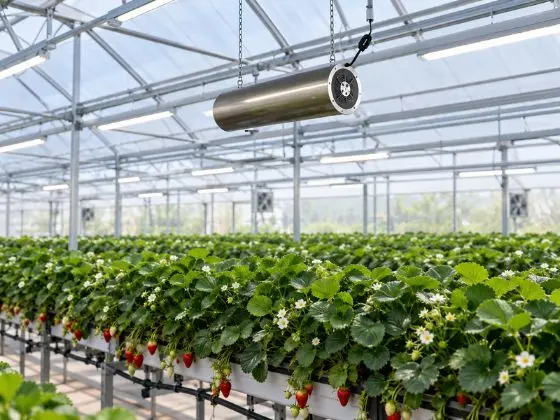
Standalone or portable units draw air from a room, treat it internally and return it to the growing environment.
These may be suitable for individual propagation rooms, isolated growing compartments or facilities without central ventilation.
When evaluating these units, growers should consider airflow capacity, treatment performance, filtration options, maintenance requirements and suitability for humid environments.
Upper room UV-C systems
Upper room UV-C systems use specially designed fixtures to irradiate air in the upper part of a room. Air movement carries contaminated air through the treated zone.
These systems may be appropriate for some large, high-ceiling facilities, but they require careful design to control radiation exposure and ensure adequate air mixing.
They are generally less straightforward to implement safely in low-ceiling growing rooms or areas where foliage extends into the treatment zone.
What should growers consider before installing UV-C air disinfection?
Choosing a suitable system requires more than selecting a lamp with a particular wattage.
The target pathogen
Different microorganisms vary in their susceptibility to UV-C. Growers should identify the main disease concern and establish whether airborne transmission is a significant route of infection.
A system validated against one microorganism should not automatically be assumed to perform equally well against another.
Airflow and exposure time
Air must receive a sufficient UV-C dose to achieve the intended level of inactivation.
High airflow can reduce exposure time, while poor air mixing may allow some air to bypass the treatment zone. System design should balance treatment effectiveness with the volume of air processed.
Plant species and growth stages
Different plants can have different sensitivities to ultraviolet radiation. Seedlings, young foliage, flowers and sensitive ornamental varieties may be particularly important considerations when assessing direct exposure.
Enclosed air treatment helps minimise this concern by separating the UV-C source from the crop.
Humidity and operating conditions
Greenhouses can have high humidity, condensation and substantial temperature fluctuations.
Equipment should be suitable for the intended environment, with appropriate electrical protection, corrosion resistance and maintenance access.
Worker safety
Germicidal UV-C can injure skin and eyes. Equipment should be appropriately shielded, with suitable safety interlocks, installation controls and maintenance procedures.
How can UVC air disinfection fit into an integrated plant-health strategy?
UV-C is most useful when considered alongside established horticultural hygiene practices rather than as a replacement for them.
A comprehensive strategy may include:
- Regular cleaning and disinfection of benches, tools and growing areas.
- Appropriate ventilation and humidity management.
- Careful irrigation practices to reduce unnecessary leaf wetness.
- Inspection and isolation of infected plants.
- Effective management of growing media, water and plant material.
- Biological controls and other disease-management measures where appropriate.
- Air filtration or other air-treatment methods suited to the facility.
Combining appropriate measures can address multiple routes of disease transmission and reduce reliance on any single intervention.
Frequently asked questions about UV-C air disinfection in plant nurseries
Can UVC light kill airborne fungal spores in a greenhouse?
UV-C can inactivate susceptible fungal spores when they receive a sufficient dose. The effectiveness depends on the fungal species, spore characteristics, UV intensity, exposure time and system design. Performance against a specific plant pathogen should be validated under relevant conditions.
Is UV-C air disinfection safe for plants?
Direct UV-C exposure can damage plants, and sensitivity varies between species and growth stages. Enclosed, in-duct systems can treat air while preventing direct exposure of crops to the UV-C source. Appropriate installation and safety controls remain essential.
Can UV-C prevent powdery mildew and grey mould?
UVC air treatment may reduce the number of viable airborne spores associated with diseases such as powdery mildew and grey mould. However, it cannot guarantee disease prevention or eliminate established infections. Results depend on the pathogen, its transmission routes and the treatment system.
Is UV-C better than HEPA filtration for greenhouse air?
UV-C and HEPA filtration work differently. HEPA filters physically capture airborne particles, while UV-C inactivates susceptible microorganisms that receive an adequate dose. A combined system may offer complementary benefits, depending on the application, airflow requirements and maintenance needs.
What is the best UV-C system for a plant nursery?
There is no single best system for every nursery. Enclosed in-duct UV-C is a useful starting point for facilities with mechanical ventilation, while recirculating units may suit individual growing rooms. Selection should account for room volume, airflow, target pathogens, crop sensitivity, safety and verified treatment performance.
Can UV-C air disinfection replace ventilation?
No. UV-C air treatment does not replace appropriate ventilation, humidity management, sanitation or other essential plant-health measures. It should be considered an additional control within a wider environmental management strategy.
Does UV-C air disinfection work for every plant species?
The air-treatment technology is not inherently limited to a particular plant species, but the suitability of the installation depends on the growing environment. Enclosed systems can be particularly useful in mixed-species facilities because they minimise direct crop exposure. The relevant pathogen and required treatment performance still need to be considered.
Conclusion: is UV-C air disinfection worth considering for plant nurseries?
UV-C light offers a promising approach to reducing susceptible airborne microorganisms in plant nurseries, greenhouses and controlled growing environments.
When correctly designed, enclosed UV-C air treatment systems can help manage airborne microbial loads while minimising direct exposure of plants and workers. They may be particularly useful in facilities where airborne disease transmission is an identified concern and where environmental control is important to crop quality.
However, effective implementation requires careful attention to pathogen susceptibility, UV-C dose, airflow, equipment maintenance and radiation safety. UV-C should complement, rather than replace, good horticultural hygiene and integrated disease management.
For growers exploring new ways to improve growing-environment hygiene, UV-C air disinfection is a technology worth evaluating against the specific needs of their facility.