As the food manufacturing sector continues to seek out highly effective, chemical-free methods to eliminate pathogens and extend shelf life, germicidal UV-C light has become a major talking point.
However, when it comes to processing fresh meat, the regulatory landscape depends entirely on where your facility is located.
Operating across the UK and the European Union requires navigating two vastly different legal frameworks regarding direct food irradiation. Misunderstanding these rules can lead to severe compliance failures or, conversely, missed opportunities to optimize your processing line.
Here is a definitive guide on where UV-C can (and cannot) be used legally in meat processing facilities across the UK and Europe.
The Strict EU Stance: Direct meat irradiation is prohibited
If your facility is located within the EU – the rules regarding direct surface decontamination are clear: it is strictly prohibited.
Under core EU food hygiene regulations, the European Commission maintains that food safety must be achieved through rigorous hygiene standards and Hazard Analysis Critical Control Point (HACCP) systems from the start. The EU firmly rejects using non-thermal physical or chemical treatments to “clean up” contaminated meat at the end of the production line.
While the overarching EU framework on food irradiation (Directive 1999/2/EC) permits the concept of treating food with radiation, the EU-wide “positive list” (Directive 1999/3/EC) limits this practice solely to dried aromatic herbs, spices, and vegetable seasonings.
Individual member states mirror this rigidity locally. Furthermore, retained European food laws explicitly instruct official veterinarians to declare fresh meat unfit for human consumption if it has been in admissibly treated with ionizing or UV radiation.
The UK Green Light: Direct surface treatment is permitted
For food processors operating within the United Kingdom, the regulatory picture is significantly different, and much more permissive.
In the UK, direct surface irradiation of fresh meat using UV-C light is legally allowed. This flexibility stems from how UK authorities define the technology:
- No “Irradiation” Classification: The Food Standards Agency (FSA) explicitly states that UV radiation does not fall within the scope of The Food Irradiation (England) Regulations 2009 (and parallel regulations in Scotland, Wales, and Northern Ireland). Because the UK separates UV-C light from standard ionizing radiation (like gamma rays or electron beams), there is no domestic legislation prohibiting the direct surface treatment of food with UV light.
- No Special Labelling Requirements: Unlike standard irradiated foods, which must be clearly marked on packaging with phrases like “treated with ionising radiation,” the FSA has clarified that there is no special labelling requirement for foods treated with UV-C light.
UK processors can confidently use direct UV-C exposure over conveyor belts or packaging lines to eliminate surface pathogens like Salmonella or E. coli, provided the treatment does not alter the nutritional value or composition of the food in a way that triggers Novel Foods regulations.
Where UV-C is universally approved: Environmental sanitation
Regardless of whether you operate under UK or EU jurisdiction, UV-C technology is highly encouraged and legally compliant when used for indirect and environmental sanitation within food facilities:
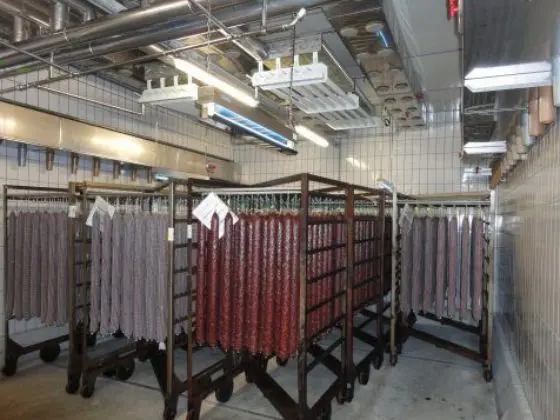
- Advanced air disinfection: Airborne moulds and bacteria are primary drivers of spoilage in processing rooms and cold storage. Treating the ambient air is fully compliant everywhere. In fact, standards like EU Regulation 2024/1141 regarding beef dry-aging actively highlight the role of UV-C or specialized filtration systems in treating the air around evaporators to prevent pathogen spread.
- Surface and tool decontamination: UV-C lamps can be safely integrated into automated cleaning protocols to disinfect non-food contact surfaces, empty conveyor belts between shifts, meat hooks, slicing blades, and packaging machinery.
Ensuring process reliability and worker safety
If you are introducing UV-C into a food production environment, whether for direct meat treatment in the UK or environmental sanitation in the EU, you must account for two critical operational elements:
- Process Monitoring: For critical control processes, UV-C levels must be monitored using specialized radiometers and dosimeters. Because UV lamps naturally degrade over time, automated monitoring ensures the system maintains its germicidal efficacy without dipping below required thresholds.
- Occupational Exposure: Artificial UV-C light sources carry strict legal obligations under workplace safety laws. Because germicidal UV can cause severe eye and skin irritation, open-air disinfection systems must be paired with robust UV hazard awareness training for staff, alongside regular workplace radiation surveys to guarantee statutory exposure limits are never exceeded.
Summary for food processors
If you are operating in the EU, target your UV-C systems strictly at the air and the processing infrastructure. If you are operating in the UK, you have the added legal flexibility to safely irradiate the meat surfaces directly to enhance shelf life and food safety.
At Arden Ultraviolet, we combine high-performance UV-C equipment with full health, safety, and regulatory compliance support. Whether you are looking to introduce UV air disinfection to a European facility or need direct product decontamination systems and safety surveys in the UK, our expert team is here to guide you.
You can browse our full range of UV-C disinfection products or learn more about the use of UV technology in the food sector.
Contact us today at +44 (0) 1564 200 826 or get in touch to discuss your process requirements.