Key takeaways
- UV-C light at 254 nm inactivates airborne bacteria, moulds and viruses by damaging their DNA, without chemicals, residues or added moisture.
- Cleaner air helps protect exposed product, packaging and people, and can support shelf life and audit confidence.
- UV-C air disinfection works alongside cleaning and good hygiene practice. It does not replace them.
- Arden Ultraviolet supplies the ULE1000 and ULE2000 air disinfection units for food production environments across the UK and Europe.
Food producers invest heavily in surface cleaning, sanitation schedules and environmental monitoring. Yet the air moving through a production hall is often the least controlled contamination route. Every door opening, forklift movement, trolley wash and shift change stirs up microorganisms that can settle onto product, packaging and equipment.
UV-C air disinfection tackles this hidden route. Here’s how the technology works, what it can deliver, and how to decide whether it suits your facility.
Why airborne contamination matters in food production
Air carries bacteria, mould spores, yeasts and viruses, often attached to dust, moisture droplets or fibres. In a food facility, these come from many sources: incoming raw materials, packaging, people, pallets, drains, wash-down activity and outside air.
Once airborne, they can travel between zones and settle on exposed product, food-contact surfaces and open packaging. The consequences can include:
- Shortened shelf life, particularly for chilled products where mould and spoilage organisms are a constant risk
- Cross-contamination between raw and ready-to-eat areas
- Product rework, withdrawals or waste
- Audit non-conformances under frameworks such as BRC, IFS and HACCP-based systems
- Brand and reputational damage if a contamination event reaches the customer
Cleaning and sanitation deal with surfaces. Air is a continuous, moving route that surface cleaning alone cannot address. That gap is where UV-C air disinfection helps.
What is UV-C air disinfection?
UV-C air disinfection uses germicidal ultraviolet light to inactivate microorganisms as air passes through or around a UV-C source. Ultraviolet light sits just beyond the visible spectrum. UV-C is the shortest and most germicidal band, and low-pressure mercury lamps emit most of their UV-C output at 254 nanometres (nm), close to the peak of DNA absorption.
In practice, a UV-C air disinfection unit draws or circulates room air past enclosed lamps. Microorganisms in that air receive a dose of UV-C, and the treated air returns to the room. Nothing is added to the air, so there are no fumes, residues or condensation to manage.
How 254 nm UV-C light inactivates microorganisms
When UV-C photons at 254 nm are absorbed by a microorganism’s DNA or RNA, they cause adjacent molecules to bond abnormally, forming structures known as dimers. This damage stops the organism from replicating and carrying out normal cell functions. An organism that can’t replicate can’t multiply or cause contamination or infection.
Two further points are worth knowing:
- Dose matters: UV dose is irradiance (the intensity of UV-C) multiplied by exposure time. A higher dose gives a greater reduction.
- Organisms differ: Vegetative bacteria are generally easy to inactivate. Mould spores and some viruses are more resistant and need a higher dose.
What is a log reduction?
Microbial reductions are expressed in “logs”. Each log is a tenfold (90%) reduction in the remaining population:
Log reduction Percentage reduction Example: 100,000 organisms become…
| 1-log | 90% | 10,000 |
| 2-log | 99% | 1,000 |
| 3-log | 99.9% | 100 |
| 4-log | 90.99% | 10 |
| 5-log | 90.999% | 1 |
This is why you’ll see claims such as “up to 99.999%” for UV-C systems. They describe a 5-log reduction under defined test conditions. Real-world performance depends on lamp output, airflow, air mixing, room layout and the organisms present, which is why a facility-specific assessment is worthwhile.
The benefits of UV air disinfection for food producers
Protecting product and extending shelf life
Mould spores and spoilage bacteria that land on exposed product are a leading cause of early spoilage. Reducing the number of viable organisms in the air lowers the number available to settle on product during processing, slicing, portioning and packing. For chilled and ready-to-eat products, this can contribute to longer, more consistent shelf life and fewer customer complaints.
Cleaner packaging and fewer rework issues
Packaging is exposed to room air while it is stored, opened and filled. Airborne contamination in crate storage halls and packaging rooms can transfer to the surfaces your product touches. Treating the air in these areas helps keep packaging cleaner before it is sealed.
Supporting staff wellbeing
Food production often means close-quarters working and cool, humid, poorly ventilated spaces. Reducing airborne microorganisms can contribute to a healthier working environment and may help limit the spread of airborne illness between colleagues. That supports workforce wellbeing and can reduce disruption from sickness absence.
A chemical-free, residue-free process
UV-C disinfection adds no chemicals, fogs or moisture to your environment. There are no residues to manage, no re-entry delays after treatment and no concerns about chemical contact with food. Units can run continuously, so protection is working throughout production rather than only at set intervals.
Strengthening audit confidence
Auditors and retail customers expect robust, layered hygiene controls. UV-C air disinfection adds a documented, measurable layer to your environmental control programme, and it can be checked with UV measurement equipment and a lamp-replacement schedule.
Low running costs
UV-C air units use modest power relative to the area they protect, with lamps rated for thousands of hours of operation. Predictable lamp replacement keeps maintenance simple and budgets easy to forecast.
Where is UV-C air disinfection used in food facilities?
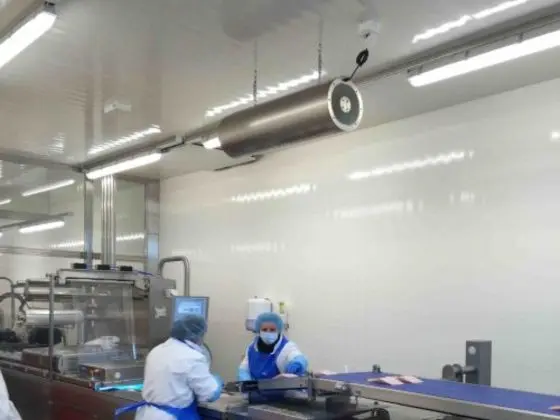
UV-C air units are typically used where air quality directly affects product or packaging, including:
- Production and processing halls
- Slicing and portioning areas
- Deboning and cutting rooms
- Packaging rooms and crate or tray storage halls
- Chilled and ambient storage rooms
- Hygiene airlocks and changing areas
- Laboratories and food service areas
What to consider when choosing a UV air disinfection system
- Room size and air movement: Rooms with poor air circulation need units with their own fan. Larger or busier spaces need higher UV-C capacity.
- Contamination level and occupancy: Rooms with constant occupancy or high contamination need robust, continuous-duty equipment.
- Construction: Stainless steel housings suit wash-down environments and protect the lamp.
- Lamp life and maintenance: Check lamp lifetime and how easily lamps can be replaced.
- Mounting: Wall or ceiling mounting with straightforward installation reduces downtime.
- Safety and compliance: UV-C is hazardous to eyes and skin, so units must be designed and installed so staff are not exposed. Organisations using artificial UV sources have obligations under UK and European law.
- Verification: Ask how performance and lamp condition will be monitored over time.
UV-C should be treated as one layer in a wider hygiene programme alongside cleaning, sanitation, personnel hygiene, filtration and good airflow design.
Arden Ultraviolet’s ULE1000 and ULE2000 air disinfection units
We supply professional UV-C air disinfection equipment for food production and other demanding environments, with expert guidance and UV safety support alongside the hardware. Our ULE range covers rooms of different sizes and conditions.
ULE1000: UV-C air circulation unit for small and low-airflow spaces
The ULE1000 is a high-quality UV-C air circulation unit designed for rooms with low air movement.
- UV-C lamp with a lifespan of up to 16,000 hours
- Reduces airborne microorganisms by up to 99.999%
- Integrated fan distributes air evenly across the lamp for uniform disinfection
- Stainless steel housing fully protects the lamp and supports safe operation
- Simple lamp replacement via a screw socket
- 40 W, 230 V
It is well suited to small production areas, laboratories, food service areas and hygiene airlocks.
ULE2000: robust UV-C air disinfection for demanding environments
The ULE2000 is specially developed for rooms with constant occupancy, challenging conditions or high contamination levels. Its robust design supports safe, continuous operation.
- UV-C lamp with a lifespan of up to 16,000 hours
- Reduces airborne microorganisms by up to 99.999%
- Integrated fan distributes air evenly across the lamp for uniform disinfection
- Stainless steel housing fully protects the lamp and supports safe operation
- Simple lamp replacement via a screw socket
- Available in several configurations: ULE2000-2 (92 W), ULE2000-4 (175 W), ULE2000-6 (265 W) and ULE2000-4 EX
- UV lamps available with splinter protection on request
It is suited to production areas, crate storage halls, packaging rooms, storage rooms, deboning rooms and slicer areas.
Support beyond the equipment
We help you select the right unit for your process, and we offer UV safety and compliance support, including risk management training and workplace radiation surveys, so your team can use UV-C confidently and meet its legal obligations.
Frequently asked questions
Does UV-C air disinfection replace cleaning?
No. It reduces airborne contamination and complements cleaning, sanitation and good hygiene practice.
What does 254 nm mean?
It is the wavelength at which low-pressure UV-C lamps emit most of their germicidal energy. It is absorbed strongly by DNA and RNA, which is why it is so effective at inactivating microorganisms.
What does a 99.999% reduction mean?
It is a 5-log reduction: only 1 in 100,000 organisms remains. Results depend on the system, airflow and conditions.
Is UV-C safe to use in occupied rooms?
Enclosed units are designed so lamps are shielded. Direct UV-C exposure is hazardous, so correct installation, labelling and a risk assessment are essential.
How often do UV-C lamps need replacing?
It depends on the lamp. The UV lamps are rated for up to 16,000 hours.
Can the units be installed in existing facilities?
Yes. Both the ULE1000 and ULE2000 are designed for straightforward installation.
Talk to our team about UV air disinfection for your facility
Every food production site is different, with its own layout, airflow, products and risks. If you’d like to learn more, or receive a proposal and quotation for your specific facility, our team would be happy to discuss your requirements.