UV-A Irradiance Meter
£495.00
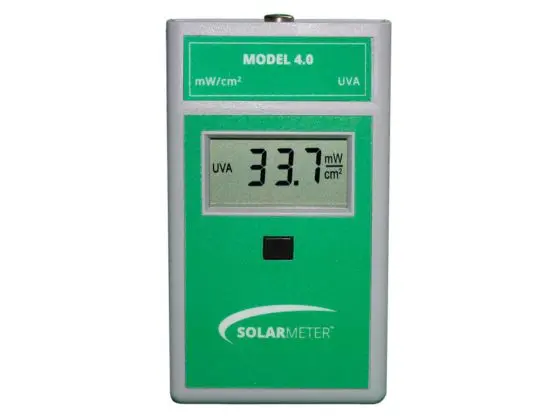
NIST traceable, hand-held UV light irradiance meter with integral sensor.
- Compact, Handheld, and Durable
- Simple Single-Button Operation
- NIST Traceable Accuracy
- LCD Display
Applications include monitoring UV lamp irradiance to help schedule maintenance and testing transmission of shielding, guarding and PPE.
Description
Sensor
The sensor consists of a GaAsP photodiode and a UV filter. It is completely insensitive to visible light longer than 400 nm and infrared radiation, because its spectral response only covers the UV-A region from 320 – 400 nm.
Operation
To operate your UV meter, aim the sensor window located on the top panel of the meter directly at a UV source. Press and hold the push-button switch on the face of the meter. For best results take note of the distance the reading was taken from the UV source in order to ensure repeatable results. Battery operation voltage is viable from 9V down to 6.5V. Below 6.5V, the numbers on the LCD display will begin to dim, indicating the need for battery replacement. Under typical service load, a standard 9V battery will last approximately 2 years.
Technical specification
| Irradiation Range | 0-199.9 mW/cm² |
| Response | 320-400 nm |
| Resolution | 0.1 mW/cm² |
| Conversion Rate | 3.0 Readings/Sec |
| Display | 3.5 Digit LCD |
| Digit Size | 0.4 (in) / 10.2 (mm) high |
| Operational Temperature | 32°F to 100°F / 0°C to 37.8°C |
| Operational Humidity | 5% to 80% RH |
| Accuracy | ±10% REF.NIST |
| Dimensions | 4.2L x 2.4W x 0.9D (in) / 106.7L x 61W x 22.9D (mm) |
| Weight | 4.5 (oz) / 128 (g) Including Battery |
| Power Source | 9-Volt DC Battery |
| Lens | UV Glass |
| Diffuser | Teflon |
| Agency Approval | CE Mark |
Instructions for use
- Wear skin and eye protection when checking UV lamps.
- Allow lamps to warm-up prior to taking readings (at least 5 minutes).
- When checking lamp aging, make sure to use the same location and distance to ensure accurate readings.
- Lamps should be replaced when output drops to about 70% of their original readings.
- For curing lamps, hold the meter at the distance you intend your work piece to be cured.
- For transmission testing, take readings with and without materials at a fixed distance.
- When comparing different types of lamps consider readinsgs to be relative rather than absolute.
- Lamps that peak near 365 nm (newer designs) will read higher than lamps that peak near 350 nm.
- Do not subject the meter to extremes in temperature, humidity, shock or dust.
- Use a dry, soft cloth to clean the instrument. Keep sensor free of oil, dirt, etc.
Request a quotation
To request a quotation, check lead times or discuss your UV requirements in more detail, please complete the enquiry form.
Our friendly team will help identify the most suitable items based on your particular requirements.
Speak to a member of our team