UV-A blacklights are an essential quality control tool throughout the electronics manufacturing process – but the radiation they emit carries real health risks that many organisations are still failing to manage.
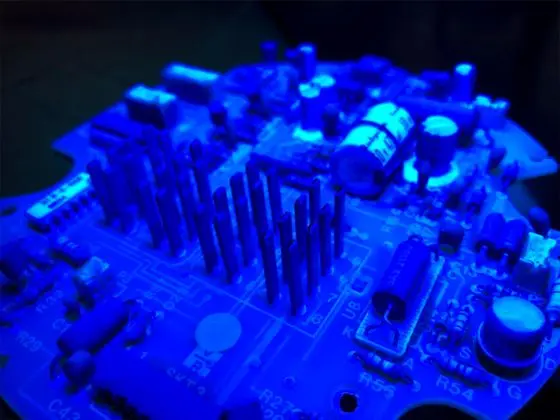
In electronics manufacturing and PCB assembly, UV-A fluorescent inspection is a well-established technique used across a range of quality control and process verification applications. UV-A blacklights (emitting in the 315–400 nm wavelength range) are used to excite fluorescent materials, making otherwise invisible features immediately visible to the naked eye under darkened or semi-darkened conditions.
Typical applications in this sector include:
- Inspection of conformal coatings on PCBs – many coating materials are formulated with UV-fluorescent tracers to allow rapid, non-destructive coverage verification before and after assembly.
- Detection of flux residues, adhesive contamination and process fluids that may compromise board performance or reliability.
- Verification of UV-cured adhesives and potting compounds used in component bonding and encapsulation.
- Inspection of UV-sensitive inks and markings used in component identification, traceability and serialisation.
- Quality control of cleanliness on board surfaces prior to coating or soldering processes, where fluorescent contaminants indicate inadequate cleaning.
These inspections are often carried out in close proximity to the source, either with operators holding handheld UV lamps directly over boards, or working within fixed UV inspection stations – sometimes repeatedly throughout a shift.
The cumulative nature of this exposure is a factor that is frequently overlooked.
Legal obligations under the Control of Artificial Optical Radiation at Work Regulations 2010
The Control of Artificial Optical Radiation at Work Regulations 2010 (CAOR 2010), which implement European Directive 2006/25/EC into UK law, impose clear legal duties on employers whose workers are exposed to artificial optical radiation – including UV-A emitted from inspection equipment. These obligations apply whether the equipment is a simple handheld blacklight torch or an integrated UV inspection station on a production line.
Under the Regulations, employers are required to:
- Assess the risk to workers from exposure to artificial optical radiation.
- Measure and assess personal exposure, to determine whether the statutory Exposure Limit Values (ELVs) are likely to be exceeded.
- Implement appropriate technical and organisational control measures to eliminate or reduce exposure so far as is reasonably practicable.
- Provide workers with suitable information and training on the risks and the controls in place.
- Maintain documented records of assessments, control measures and training provided.
In electronics environments, where UV-A inspection may be conducted by multiple operators across multiple shifts, the cumulative daily exposure of individual workers can be significant. A risk assessment that relies on assumptions rather than actual measurement is unlikely to be sufficient to demonstrate compliance – particularly if exposure levels are later found to exceed the ELVs.
Health risks from UV-A exposure
UV-A radiation (315–400 nm) is often perceived as the ‘safer’ end of the UV spectrum because it does not produce the immediate sunburn reaction associated with shorter UV-B and UV-C wavelengths. This perception is misleading and can create a false sense of security in workplaces where UV-A sources are used regularly.
The established and potential health risks from occupational UV-A exposure include:
- Photokeratitis and photo conjunctivitis – acute inflammation of the eye’s surface tissues which, although rare – can result from unprotected exposure to intense UV-A sources, particularly at close range.
- Accelerated development of cataracts with long-term, repeated exposure to UV-A radiation, which penetrates deeper into the eye than shorter wavelengths.
- Skin effects including erythema, accelerated photo ageing and, with sustained exposure, an increased risk of skin cancer.
Without proper measurement and assessment, it is not possible to know whether the exposure levels experienced by your operators are within the statutory limits, or whether the control measures currently in place are actually effective. Many organisations discover through assessment that their exposure levels exceed the ELVs, or that the PPE in use does not provide adequate attenuation at the wavelengths emitted by their equipment.
How Arden Ultraviolet can help
At Arden Ultraviolet, we work with electronics manufacturers, EMS providers and PCB assembly operations to help them understand, assess and manage the risks associated with UV-A inspection processes. With two decades of UV industry experience and a client base that includes major global organisations, we provide independent, practical support that goes beyond generic guidance.
Our UV Safety and Compliance Package for electronics operations includes:
- UV Risk Management Training for safety professionals and those responsible for UV processes — covering the health effects of UV radiation, statutory ELVs, and legal obligations under the CAOR 2010 Regulations.
- On-site UV Exposure Assessment — measurement of UV irradiance levels at each inspection position, assessment of personal daily exposure, and comparison against the statutory ELVs, with a written report and compliance statement.
- UV Hazard Awareness Training for operators working with or near UV-A inspection equipment — a legal requirement under the Regulations, tailored to your specific processes and equipment.
- Guidance on engineering controls, administrative controls and PPE selection appropriate to the specific UV-A wavelengths and equipment in use.
If your organisation uses UV-A blacklights for conformal coating inspection, flux detection, or any other PCB or electronics inspection process, we would welcome the opportunity to discuss your current arrangements and how we can help ensure you are fully compliant and your workers are properly protected.