UV-C Disinfection for Veterinary Practices
Eliminating Bacteria and Viruses from Treatment Rooms
Veterinary practices face a daily battle against some of the most resilient and dangerous pathogens in the clinical environment. From multi-drug-resistant bacteria persisting on treatment benches to hardy viruses that survive on surfaces for weeks, standard chemical cleaning alone often cannot guarantee the level of decontamination needed to protect patients, staff and clients. UV-C disinfection for veterinary practices offers a proven, chemical-free solution.
What Is UV-C disinfection and how does it work?
UV-C refers to ultraviolet light in the 200–280 nanometre wavelength range – a band of the electromagnetic spectrum with powerful germicidal properties. When UV-C photons strike a microorganism, they penetrate its cell wall and cause direct, irreparable damage to its DNA or RNA. This prevents the pathogen from replicating, effectively killing it without the use of any chemicals.
At approximately 254–265 nm (the peak germicidal wavelength) UV-C is effective against bacteria, viruses, fungi and their spores. Critically, because it acts physically on genetic material rather than chemically, pathogens cannot evolve or develop resistance to UV-C irradiation. In an era of growing antimicrobial resistance, this is a significant advantage.
UV-C disinfection is best understood as a powerful complement to standard cleaning and chemical disinfection protocols, not a replacement for them. Used together, the two approaches achieve a level of pathogen reduction that neither can reliably deliver alone.
UV-C disinfection in veterinary environments: What the evidence shows
The use of UV-C in veterinary settings is backed by peer-reviewed research. A 2021 study published in the American Journal of Veterinary Research evaluated UV-C disinfection across four veterinary facilities – including equine and small animal referral hospitals and a necropsy suite. The results were striking: a single 45-minute UV-C treatment cycle reduced mean bacterial bioburden across all tested surfaces by 94%. A second UV-C treatment cycle achieved a 99% reduction, with no detectable bacteria found on four of the ten surfaces sampled in the small animal operating theatre.
Importantly, the same study found that all surfaces retained a viable bacterial population even after manual cleaning alone – confirming that UV-C delivers measurable improvements over standard protocols.
Laboratory research has also demonstrated greater than 5 log reduction (a 99.999% decrease) in Porcine Parvovirus and Senecavirus A following a single five-minute UV-C exposure, and effective inactivation of a broad range of veterinary viruses including Swine Influenza Virus, Bovine Viral Diarrhoea Virus and Porcine Reproductive and Respiratory Syndrome Virus.
For bacteria, a minimum dose of 270 J/m² of UV-C has been shown to achieve greater than 95% germicidal activity against both gram-positive and gram-negative organisms – covering the majority of clinically relevant veterinary pathogens.
Ceiling and wall-mounted UV-C lamps for veterinary treatment rooms
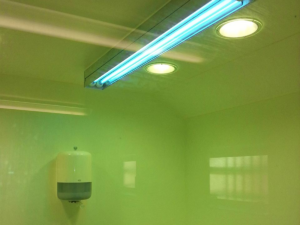
Our ceiling and wall-mounted UV-C germicidal lamp systems are designed for installation in veterinary treatment rooms, consulting rooms, surgical suites, isolation wards and kennel areas. They provide whole-room disinfection – covering surfaces, equipment, benches and circulating air – reaching areas that manual cleaning and chemical disinfectants routinely miss.
Overnight disinfection cycles
The most common use pattern in veterinary practices is overnight scheduling. Once the last patient has left and staff have completed routine cleaning, the UV-C system activates automatically, running a timed disinfection cycle through the night. By the time the practice opens the next morning, the treatment room has received a full germicidal dose with no manual effort required.
Between-consultation disinfection
For practices with shorter turnaround windows between appointments, UV-C systems can also be programmed to run brief disinfection cycles in between patients. A 10–20 minute cycle during a scheduled gap can significantly reduce microbial load on surfaces before the next animal enters the room.
What our ceiling and wall-mounted systems include
Every installation we carry out includes:
- Recommendations for lamp quantity and positioning to maximise room coverage and minimise shadow zones
- Supply of germicidal UV-C lamps and all mounting hardware
- Full safety training for all relevant staff, clinical and non-clinical
- Written operating procedures, UV-C hazard signage and a site-specific risk assessment
Enclosed UV-C disinfection cabinets for veterinary instruments and tools
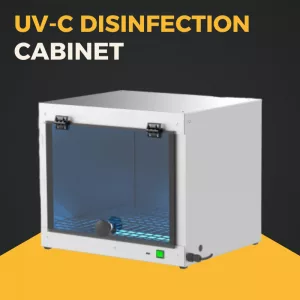
Where a full room cycle is impractical between back-to-back appointments, our enclosed UV-C disinfection cabinets offer a rapid alternative for instruments and reusable items.
These compact cabinets are designed to sit on a worktop or stand freely in a clinical area, and they provide effective surface disinfection on veterinary tools within minutes – substantially reducing the risk of cross-contamination between patients. The enclosed design means all UV-C radiation is fully contained, making the cabinets safe to operate even with staff present in the room.
Items commonly disinfected between consultations include stethoscopes, thermometers, otoscopes, endoscopes, surgical scissors, clippers and other handheld instruments. The highly reflective interior surfaces eliminate shadow zones, ensuring even exposure across items of irregular shape.
Cabinet systems are plug-in and require no installation. Every unit we supply comes with written operating instructions for your team.
Veterinary pathogens that UV-C disinfection can help control
UV-C is effective against a wide range of organisms relevant to veterinary practice. Below are some of the pathogens of greatest concern, where UV-C disinfection can form a meaningful part of infection control.
MRSA and MRSP (Methicillin-Resistant Staphylococci)
Methicillin-resistant Staphylococcus aureus (MRSA) and S. pseudintermedius (MRSP) are among the most frequently isolated nosocomial pathogens on veterinary clinic surfaces, including treatment benches, cages, water taps and door handles. Their multi-drug resistance makes conventional chemical options less reliable and UV-C an especially valuable adjunct.
Clostridium difficile
C. diff has been detected on surfaces in veterinary rehabilitation and treatment clinics. Its ability to form highly resilient spores makes it resistant to many standard chemical disinfectants, and UV-C irradiation is recognised as an effective complementary approach.
Pseudomonas aeruginosa
Commonly found on wet surfaces in veterinary environments, P. aeruginosa can cause serious wound infections and urinary tract infections in post-surgical patients. It has been isolated from approximately 30% of sampled veterinary clinic environments and is a significant concern in practices with hydrotherapy or rehabilitation facilities.
Bordetella bronchiseptica and Canine Parainfluenza Virus (Kennel Cough)
Kennel cough – caused primarily by Bordetella bronchiseptica together with canine parainfluenza virus – spreads rapidly via aerosolised secretions and contaminated surfaces in waiting rooms and kennels. UV-C provides effective inactivation of both the bacterial and viral components, and can be particularly valuable in practices that see high volumes of boarding, rescue or multi-dog households.
Canine Parvovirus
Parvovirus is notoriously resistant to heat, cold, humidity and drying, and can remain viable on environmental surfaces for extended periods. Research has demonstrated greater than 5 log reduction in related parvoviruses following UV-C exposure, making it a powerful tool in practices that routinely handle unvaccinated or suspected parvoviral cases.
Feline Calicivirus and Feline Herpesvirus
These common causes of feline upper respiratory disease persist on clinic surfaces and shared equipment such as thermometers, otoscopes and examination tables. UV-C disinfection cabinets are particularly well suited for rapid decontamination of instruments between feline consultations.
Dermatophytes (Ringworm)
Microsporum canis and other ringworm-causing dermatophytes represent a persistent zoonotic risk in veterinary practices — transmissible to staff as well as other animals. UV-C effectively disrupts fungal DNA, and is recommended as a supplementary decontamination measure in consulting rooms that have seen confirmed ringworm cases.
Multidrug-Resistant Enterobacteriaceae (MDR E. coli and related species)
MDR Escherichia coli and related gram-negative enteric bacteria are recovered from 76–89% of sampled veterinary clinic environments. As the range of effective chemical options narrows, UV-C provides reliable inactivation without contributing to further resistance development – one of its most clinically important advantages.
UV-C safety in veterinary practices: What you need to know
UV-C light is highly effective precisely because it damages biological material – which is why rigorous safety implementation is essential. No UV-C system should be operated without appropriate safeguards and trained staff.
Ceiling and wall-mounted systems should incorporate occupancy interlocks that prevent the lamps from activating if the room is occupied. All installations can be commissioned by a full site-specific risk assessment. Our enclosed cabinets are inherently safe for use with staff present, as all UV-C radiation is fully contained within the unit.
Critically, our safety training is included as standard with every solution we supply – not offered as an optional extra. We provide hands-on training sessions for all relevant staff, covering safe operation, emergency procedures, scheduled maintenance checks and signage requirements. We also offer annual output testing and lamp replacement services, since UV-C lamp output degrades gradually over time and maintaining the correct germicidal dose requires regular monitoring.
Why choose our UV-C consultancy for your veterinary practice?
We specialise in UV-C disinfection consultancy and work with veterinary practices of all sizes – from single-vet rural clinics to large multi-site groups. Our solutions are always specified to your exact layout and clinical workflow, and we never take a one-size-fits-all approach to system design.
Every solution we supply includes equipment and comprehensive safety training as a complete package. You will not be left to implement or operate a UV-C system without the knowledge and procedures to do so safely.
If you would like to discuss UV-C disinfection for your veterinary practice, request a free site survey, or find out more about our enclosed disinfection cabinets, please get in touch with our team.