Ultraviolet light has been a tool of forensic science for decades, but its role in everyday policing, commercial asset protection, and industrial security has grown substantially in recent years. The combination of UV-fluorescent forensic marking liquids, a rapidly maturing LED lamp market, and policy changes requiring custody screening has pushed UV detection from the laboratory into the front line of crime prevention.
This article examines how UV lamp technology is being used across policing and security applications today, the expanding range of assets being marked and protected, and the lamp specifications, wavelengths, and safety considerations that determine whether a UV inspection system performs reliably in the field.
Forensic marking – the technology at the heart of It
The concept behind UV-based forensic asset marking is straightforward: apply an invisible liquid to a valuable item, register that liquid’s unique code to the owner, and any time law enforcement illuminates the item with ultraviolet light, the presence of the liquid (and by extension the identity of the rightful owner) becomes immediately apparent.
SmartWater is a traceable liquid and forensic asset marking system applied to items of value to identify thieves and deter theft. The liquid leaves a unique identifier whose presence cannot be easily seen by the naked eye except under ultraviolet black light.
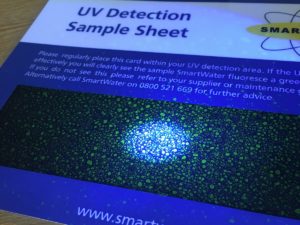
The liquid glows bright yellow-green under UV light, which is how it is detected by law enforcement. Unique forensic signatures create an irrefutable link between property and original owner.
The chemistry of these products is more sophisticated than the simple description suggests. Multiple light sources at different wavelengths cause various elements to fluoresce and other elements to phosphoresce. The presence or absence of these elements forms a binary code. This code is swabbed from a suspicious article and sent back to the lab to be analysed. The result is a layered system: a rapid visual indication under UV light in the field, backed by a laboratory-verified binary chemical signature that is legally irrefutable.
SmartWater comes in three variants — Index Solutions, Indsol Tracer, and SmartWater Instant — which use different techniques to embed a unique code. Index Solution is contained within a spray system activated by an intruder detection unit, marking the intruder with a spray that police locate using UV light. Indsol Tracer consists of a polymer emulsion that blends different chemical agents according to a binary code allowing billions of different possibilities.
These invisible but UV-detectable marking liquids have resulted in a 100% conviction rate when the evidence has been presented in court over 25 years.
Custody suites and police operations
The custody suite is where UV detection has become most systematically embedded in UK policing. Anyone arrested in the UK walks through a UV archway as they enter the custody suite, and any clothes or skin exposed will glow visibly. This blanket screening, regardless of the reason for arrest, serves a dual purpose: it recovers marked stolen property from individuals in custody, and it creates a powerful deterrent message that the criminal community is aware of.
Officers are also equipped with handheld UV torches, allowing them to detect traces of forensic marking liquid out in the field. Criminals and stolen property are routinely screened, irrespective of the reason for arrest. This blanket screening not only significantly increases deterrence but also greatly increases the likelihood of property marked with a forensic liquid being recovered and returned to its rightful owner.
The fitting of UV detectors in custody suites, mandatory checking of property, and police engaging with the receiver community – pawn brokers, second-hand dealers, are all important components of the overall strategy that increases pressure on the criminal.
The deterrent effect is not limited to property crimes. SmartWater is being given out to people suffering at the hands of stalkers and abusers. The substance can be traced to specific victims and abusers, giving police proof of contact between them. In 2022, the first person in the UK was convicted and jailed for domestic abuse using the technology, and forces across the country have been adopting it. The marking substance stays on clothing and skin for several weeks.
The technology also extends directly into retail crime prevention. During 2024, Boots recorded high volumes of stolen fragrance bottles. A forensic marking initiative using SmartWater on fragrance testers resulted in a 67% drop in stolen fragrance testers in the month following implementation. Officers were tasked with using UV lights during operations to detect and seize marked items. Once a UV light is applied to a product, it will glow yellow/green if it has been marked.
Marking metals – combating scrap metal theft
Metal theft is a persistent and economically significant crime. Copper, lead, aluminium, and steel are all targeted for their commodity value, and the challenge for law enforcement has always been that metals are largely indistinguishable once separated from their original location. Items that are stolen often, such as copper wire and other common materials, generally have no markings or serial numbers to distinguish what was stolen from what was not.
UV-fluorescent marking directly addresses this problem. Technologies like UV marking pens or microdot technology on metals make them easily identifiable if stolen and recovered by police authorities. When a scrap metal dealer receives material from an unknown seller, a UV lamp check can immediately reveal whether that material carries a forensic code – and if so, to whom it belongs.
SmartTrace can be applied to valuable external items such as lead roofs, stone, and high-value metal cable. The unique forensic code is guaranteed to last a minimum of five years, even when used outdoors, and the product has been proven to withstand fire, humidity, and sunlight.
Lead stolen from church roofs is one of the most high-profile and damaging categories of metal theft in the United Kingdom. SmartWater was assessed for suitability for use on church roofs, resulting in an order to protect 20,000 churches in the UK. Applied in bulk across roof sections, the forensic liquid marks every piece of lead, meaning that even if a roof is stripped and the lead cut into pieces, every fragment carries the same unique code back to the specific church from which it was stolen.
The same principle applies to copper cabling on infrastructure networks, aluminium from construction sites, catalytic converters, and any other metal asset with a meaningful commodity value. Catalytic converter thefts have more than halved thanks to parts being forensically marked. For scrap metal recyclers and dealers operating legitimate businesses, UV inspection capability at the point of intake is an increasingly important tool for due diligence — allowing them to identify potentially stolen material before it enters the processing chain, protecting the business from legal exposure and reputational damage.
Bicycles, domestic property, and community marking schemes
UV marking systems are well established in the domestic and community security context. Bicycles are one of the highest-volume stolen items in the UK, with recovery rates remaining stubbornly low because recovered bikes are difficult to link to their owners without visible serial numbers — which are routinely ground off by thieves.
A UV-fluorescent marking applied inside the frame, under the bottom bracket, or in other concealed locations makes any recovered bicycle immediately searchable against an ownership database. Combined with the visible deterrent signage that accompanies most consumer forensic marking kits, the dual effect of deterrence and recoverability is significantly stronger than traditional engraving or sticker-based marking alone.
The same principle applies across a wide range of domestic valuables: electronics, musical instruments, power tools, garden machinery, and sports equipment. SmartWater offers a generic form of traceability and can be used to mark almost any item, including IT equipment, jewellery, vehicles, sporting equipment, ornaments, tools, and plant machinery.
SmartWater is virtually impossible to remove and is invisible under normal light, but glows brightly under UV light, making it easily identifiable by police. Many police station custody areas throughout the country are equipped with UV detection equipment, so regardless of their crime, every time a detainee is brought through custody they will be checked.
Commercial applications: Tradespeople and work tools
The impact of tool theft on tradespeople is substantial and well documented. Tool theft remains a major issue across the UK. In 2024, more than 25,000 incidents were reported, with losses reaching around £40 million. For tradespeople, the impact is significant – stolen tools mean lost earnings, delays to scheduled work, and unnecessary pressure on professional reputations and wellbeing. Almost 90% of UK tradespeople worry about becoming a victim of tool theft, with only 1% of stolen tools ever returned.
UV forensic marking directly addresses the recovery problem. SmartWater allows construction firms to covertly mark equipment on active job sites and storage yards. A UV marking kit for a set of trade tools costs a fraction of the value of even a single mid-range power tool, and the application process is simple enough to carry out in a few minutes across an entire van load of equipment. Each marked tool carries a forensic link directly back to its registered owner, making it straightforward for police to prove provenance when marked tools turn up in custody or through a search.
The deterrent stickers that accompany these kits serve a secondary but important function: advertising the presence of forensic marking to potential thieves before they act. Research consistently shows that the combination of visible deterrent signage and actual marking is more effective than either alone. A would-be thief who cannot easily identify which tools in a van are marked – and who knows that any arrest will involve UV screening – faces a meaningfully increased risk of detection and prosecution.
For larger construction and plant hire operations, UV marking scales effectively. Equipment worth hundreds of thousands of pounds – excavators, generators, compressors, formwork – can be marked at multiple points, with the forensic code registered against a specific contract, site, or fleet number. In the event of theft, law enforcement has an immediate chain of custody that is difficult to contest in court.
High value industrial and motorsport applications
The potential for UV-based forensic marking to operate in high-value industrial environments, where assets are expensive, mobile, and frequently transported internationally is significant, and represents an area of growing interest.
Consider the operational profile of a Formula 1 team. Equipment worth tens of millions of pounds travels between circuits across multiple continents throughout the season, passing through airports, freight terminals, customs facilities, and the hands of logistics contractors. Components are stripped from cars after each race, tested, rebuilt, and returned to service. The security and traceability challenges are immense. The FIA’s newly introduced standards state that teams must be able to track and trace all components throughout their entire life cycle, from production to redundancy. While the FIA standard is met through laser-engraved data matrix codes, UV forensic marking can operate as a complementary layer – covertly identifying ownership of tools, rigs, and equipment that may not lend themselves to engraving, and providing an additional deterrent against theft during transit and at venue.
The same logic applies across a wide range of high-value industrial and commercial operations. Broadcasting and production companies transport extremely expensive equipment internationally. Medical device manufacturers ship precision instruments across complex supply chains. Aerospace and defence contractors move components between facilities and contractors where chain of custody is operationally and contractually critical.
In all of these environments, UV forensic marking adds a covert identification layer that survives transit, handling, and environmental exposure. Unlike serial numbers, which can be ground or filed away, a forensic liquid applied inside equipment housings, within cable looms, or on non-visible surfaces is extremely difficult to fully remove. SmartWater is proven to withstand fire, humidity, and sunlight, with the unique forensic code guaranteed to last a minimum of five years.
Jewellery, electronics, and high value portable assets
UV marking has clear application across jewellery and consumer electronics – two categories that represent high-volume, high-value targets for both opportunistic and organised theft.
For jewellery, the challenge is that individual pieces are difficult to distinguish and easy to move through secondary markets. A forensic marking liquid applied to a hallmark area, inside a clasp, or on the reverse of a pendant survives normal wear while providing an unambiguous ownership link if the piece is recovered. This is particularly relevant for high-value pieces where insurance replacement cost is significant: the ability to demonstrate ownership of a recovered item, and to link a convicted thief to a specific theft, has direct financial and legal value.
For electronics such as laptops, cameras, professional audio and video equipment, the combination of UV marking with asset registration creates a traceable record that is very difficult for a receiver of stolen goods to argue against. The presence of a forensic code on a seized laptop, confirmed by a UV lamp in custody, links that device to a registered owner with a forensic standard of evidence.
UV lamp technology – choosing the right tool for the application
The effectiveness of UV-based forensic marking and inspection depends entirely on the quality and specification of the lamp used to detect it. Not all UV lamps are equal, and selecting the wrong lamp for an application can mean that genuine forensic marking is missed, or that false positives generate unnecessary investigative work.
Wavelength
The most important specification is wavelength. A 365 nm wavelength is often preferred over other ranges such as 395 nm because it is true UV light, which lacks visible violet light. Pure UV emission is critical for the detection of fluorescent materials such as dyes used in penetrant tests and forensic marking.
Consumer-grade UV lamps, the inexpensive LED devices widely available online, typically emit at 395 nm or 405 nm. These will cause a UV-marked item to glow, but the visible violet light they emit simultaneously reduces contrast, making faint or degraded marks harder to see. In a brightly lit environment such as a custody suite or a vehicle stop, the difference between a 365 nm lamp with a UV-pass filter and a 395 nm lamp without one can be the difference between detecting a mark and missing it entirely.
For policing and professional security applications, 365 nm LED lamps with optical bandpass filters – which block residual visible light and pass only UV-A – are the correct specification. They produce a near-pure UV beam that causes fluorescent compounds to glow with maximum contrast against a dark background.
Irradiance
Irradiance — the intensity of UV output at a given working distance — is the second critical specification. It is typically expressed in microwatts per square centimetre (µW/cm²) measured at a standardised distance, usually 38 cm (15 inches).
Professional UV inspection lamps are available in multiple intensity levels, from around 1,000 µW/cm² for general-purpose inspection up to significantly higher outputs for demanding environments.
Higher irradiance is not always better. For custody suite screening (where the goal is a rapid pass-or-fail indication over a person’s hands, clothing, and face) a wide-beam, moderate-intensity lamp is preferable to a narrow, high-intensity spot. For detailed inspection of a small mark on a piece of jewellery or the interior of a laptop casing, a focused high-intensity lamp produces better results.
Lamp form factors
Handheld UV torches and hand lamps are the standard tool for police officers, custody staff, and field security personnel. Fixed-mount custody suite lamps are typically mains-powered, high-output units mounted in a fixed position through which detainees pass or are directed to stand. Some custody suites use dedicated UV archways or booth arrangements that allow rapid full-body screening without requiring the officer to manually sweep a torch. These fixed installations allow consistent screening of every person booked into custody, regardless of the arresting officer’s individual equipment.
Flood-type inspection lamps (larger units covering a wide area) are appropriate for scrap yard inspection counters, property store examination rooms, or any application where multiple items need to be checked quickly. These are typically mains-powered and mounted on a stand or fixed bracket above an inspection surface.
Penlight and small torches at 365 nm have legitimate use for quick personal checks, verifying that a piece of jewellery or a small item of equipment carries a forensic mark – though they lack the irradiance for reliable field inspection over larger surfaces.
Inspection area and working distance
The physical coverage of a UV lamp (the area it illuminates at an irradiance sufficient to excite the fluorescent marker) is determined by the combination of output intensity, beam angle, and working distance. For custody suite screening, a lamp that covers the full width of a person’s hands at arm’s length, with sufficient irradiance for reliable detection is the minimum specification. For scrap yard inspection of a piece of copper pipe or sheet metal, a wide-beam flood lamp allows faster and more systematic coverage. For jewellery or electronics examination, a focused spot at close working distance is more appropriate.
Safety considerations
UV-A radiation, the working wavelength range for forensic inspection lamps, is the same part of the UV spectrum responsible for tanning and UV-related skin ageing from sun exposure. Prolonged or repeated unprotected exposure of eyes or skin to high-irradiance UV-A lamps carries a risk of phototoxic injury, including corneal damage and skin erythema.
For routine use – passing a handheld lamp over a person’s hands in custody, or briefly illuminating a piece of equipment – exposure durations are short and risk is low. For extended inspection work, such as systematic examination of large quantities of property or lengthy scene searches, appropriate UV-filtering safety goggles or glasses should be worn. These do not block the fluorescence visible to the inspector; they block the UV wavelengths while transmitting the visible fluorescent emission.
Shorter UV wavelengths (below 315 nm) carry significantly higher risk to skin and eyes, are used for curing and disinfection applications, and should never be used in the context of forensic marking inspection. Any organisation deploying UV inspection lamps should ensure that staff are trained on the wavelength and type of lamp in use, understand the difference between UV-A inspection lamps and germicidal UV-C systems, and wear appropriate eye protection when using lamps at sustained high irradiance levels. Manufacturer datasheets should always be consulted, and lamps selected from suppliers who provide measured irradiance data rather than estimated or nominal figures.
The ecosystem: Making marking work
UV forensic marking is most effective when it operates as a system rather than a product. The technology functions when the following elements are all in place: assets are marked and registered to an identifiable owner; deterrent signage advertises the presence of marking to potential offenders; law enforcement has UV inspection capability in custody and in the field; and downstream receivers – scrap dealers, pawnbrokers, second-hand retailers – are alert to the presence of forensic marking and understand the consequences of handling marked goods.
The SmartWater strategy involves the fitting of UV detectors in custody suites, mandatory checking of property, and police engaging with the receiver community including pawn brokers and second-hand dealers as important components of the overall strategy that increases pressure on the criminal.
In 2017, SmartWater became accredited as compliant with the UK Government’s Forensic Science Regulator’s Codes of Practice, which became a lawful requirement in April 2021. This accreditation matters: it means that evidence produced by the system is admissible under a regulated forensic standard, and that the chain from marking to laboratory analysis to conviction is legally robust.
For any organisation considering UV forensic marking (whether a building contractor, a motorsport team, a jeweller, a parish council protecting a church roof, or a police force equipping a custody suite) the investment is modest relative to the value of the assets being protected. The lamp technology has matured significantly, 365 nm LED units have come down substantially in cost, and the forensic marking liquids themselves are inexpensive per asset marked. The principal requirement is systematic implementation: marking done consistently, deterrent signage displayed visibly, and UV inspection carried out routinely.
When those elements are combined, the evidence is clear. Forensic marking under UV light has secured thousands of convictions, returned countless items of property to their rightful owners, and (perhaps most importantly) deterred crimes that were never recorded because they were never committed.