UV Inspection in Electronics Manufacturing
The Essential Guide to Conformal Coating Validation
UV inspection is one of the most reliable and widely used quality control methods in electronics and PCB manufacturing. Whether you are validating conformal coating coverage, detecting contamination, or identifying flux residues, ultraviolet light reveals what the naked eye simply cannot see. For quality engineers and production managers working to tight tolerances and compliance requirements, understanding how to select and use the right UV inspection equipment, and how to manage it safely, is essential.
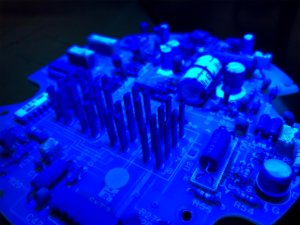
Why UV inspection matters in PCB manufacturing
Conformal coatings are applied to printed circuit boards to protect them from moisture, dust, chemicals and temperature extremes. In sectors such as aerospace, automotive electronics and industrial manufacturing, a failed or incomplete coating can result in catastrophic component failure. UV inspection provides a fast, non-destructive method of verifying that coatings have been applied correctly and uniformly across the entire board surface.
Most conformal coatings contain UV-fluorescent tracers that glow visibly under ultraviolet light, typically at a wavelength of 365nm (UVA). This allows inspectors to identify pinholes, thin spots, voids and areas of over-application in seconds – something that would be impossible to detect reliably under standard white light conditions.
Beyond conformal coating validation, UV inspection is also used throughout electronics manufacturing to detect fluorescent contaminants, verify cleanliness before coating application, and inspect solder masks and adhesive deposits. It is a versatile, cost-effective tool that adds genuine value at multiple stages of the production process.
Choosing the right UV lamp for electronics inspection
Not all UV lamps are equal, and selecting the wrong equipment can compromise your inspection results. For conformal coating validation and PCB inspection, the most effective tools operate at or around 365nm – the UVA range that excites the fluorescent compounds used in the vast majority of modern coatings without causing the same degree of UV hazard associated with shorter wavelengths.
Key factors to consider when selecting UV inspection equipment
The intensity of the UV output is critical. A lamp that appears bright to the human eye may still be delivering insufficient UV irradiance at the board surface, leading to missed defects and false pass results. This is particularly important in high-volume production environments where lamps may be in continuous use and their output degrades over time.
Beam uniformity is another factor that is often overlooked. Inconsistent output across the lamp face can create shadowed areas on the board, masking coating gaps. High-quality UV inspection lamps designed for industrial use are engineered to deliver consistent, repeatable output across the entire inspection area.
For benchtop inspection stations, high-intensity UVA lamps with filtered output are typically the preferred choice, blocking visible light to maximise fluorescent contrast. For inline and robotic inspection applications, UV LED arrays offer excellent control, long service life and minimal warm-up time.
With over 20 years of experience supplying UV equipment across the electronics, aerospace, automotive and manufacturing sectors, we regularly assist engineers and quality teams in selecting the most appropriate UV light sources for their specific inspection requirements — whether that is a single handheld blacklight for spot checks or a fully integrated UV inspection system for automated production lines.
The importance of UV process monitoring in electronics quality control
Selecting the right UV lamp is only the first step. Maintaining consistent, validated UV output throughout the lamp’s working life is equally important — and this is where UV measurement becomes indispensable.
UV meters and radiometers allow quality teams to verify that their inspection lamps are delivering the correct irradiance at the point of inspection. Regular measurement confirms that output has not degraded to a level that would compromise inspection reliability. For facilities operating under ISO 9001, IATF 16949 or AS9100 quality management systems, documented UV measurement records provide essential evidence of process control.
We supply a range of UV meters and measurement instrumentation calibrated for UVA inspection applications, and can advise on appropriate measurement intervals and acceptance criteria for your specific process. Integrating UV measurement into your quality control routine is a straightforward step that significantly strengthens your inspection process and audit readiness.
UV safety in electronics manufacturing environments
UV inspection lamps used in electronics manufacturing — including 365nm UVA blacklights — are generally considered lower risk than shorter-wavelength UV sources. However, they are not without hazard. Prolonged or repeated unprotected exposure to UVA radiation can cause cumulative damage to the eyes and skin, and employers have a legal duty to manage this risk appropriately.
Under the Control of Artificial Optical Radiation at Work Regulations 2010, which implement EU Directive 2006/25/EC into UK law, employers are required to assess the risk posed by artificial optical radiation sources – including UV inspection lamps – and put in place appropriate controls. This includes providing workers with information and training tailored to the specific equipment and processes they work with.
This is not a box-ticking exercise. Workers who use UV lamps daily, even briefly, need to understand the nature of the hazard, how to protect themselves, and what control measures are in place. Generic UV awareness information is rarely sufficient; training should reflect the actual lamps, intensities and working distances involved in your operation.
Onsite UV exposure assessment
We provide onsite measurement and assessment of personal UV exposure for electronics manufacturers and other industrial clients. Using calibrated instrumentation, our specialists measure actual worker exposure levels against the statutory exposure limit values defined in the Regulations, producing a clear, documented assessment that supports your risk assessment process and demonstrates due diligence to HSE inspectors and auditors.
UV inspection and conformal coating validation – getting it right
UV inspection is a mature, well-understood technology – but its effectiveness depends entirely on using the right equipment, maintaining it properly, and ensuring that the people using it are properly trained and protected. Cutting corners on lamp quality, skipping UV output verification or neglecting worker safety training all carry real risks: to product quality, to your workforce, and to your regulatory compliance position.
As a UK-based UV specialist with more than two decades of experience across electronics, aerospace, automotive, food production and healthcare, we understand the practical realities of UV inspection in production environments. We work with quality teams, EHS managers and production engineers to build UV inspection processes that are effective, measurable and compliant.
If you are reviewing your UV inspection setup, introducing conformal coating validation for the first time, or simply want to ensure your current process and safety arrangements are fit for purpose, we would welcome the opportunity to help.
Get in touch to discuss your requirements, arrange an onsite UV measurement visit, or find out more about our UV hazard awareness training programmes for production and safety teams.