Artificial ultraviolet light plays a vital role across a wide range of industries – from fluorescent inspection and UV curing in manufacturing, to germicidal disinfection in healthcare and food production. But UV radiation is also a recognised occupational health hazard, capable of causing serious harm to the eyes and skin if workers are not adequately protected.
For any organisation using artificial UV light in the workplace, there is a clear and specific legal framework that governs how that risk must be managed. Understanding what that framework requires – and where many organisations fall short – is the starting point for achieving genuine compliance and protecting your people.
The Control of Artificial Optical Radiation at Work Regulations 2010
The Control of Artificial Optical Radiation at Work Regulations 2010, commonly referred to as the AOR Regulations or CAOR10, implement European Directive 2006/25/EC into UK law. They came into force on 27 April 2010 and apply across Great Britain to virtually all workplaces where artificially produced sources of optical radiation are in use – including ultraviolet (UV), visible light, infrared, and laser sources.
Important: The regulations do not only apply to obviously hazardous equipment. Any artificial source of UV light in a workplace – including UV-A blacklights, UV-C germicidal lamps, and UV curing systems – must be considered in the context of the regulations.
The regulations exist because prolonged or excessive exposure to UV radiation can cause significant harm. Effects on the skin range from redness and burning in the short term, through to accelerated ageing and an increased risk of skin cancer with repeated exposure over time. Effects on the eyes include photokeratitis – a painful condition sometimes described as “arc eye” or “welder’s flash” – and, with chronic exposure, an elevated risk of cataracts.
These are not theoretical risks. They are well-documented occupational health outcomes that organisations have a legal duty to prevent.
What do the regulations require?
The AOR Regulations place a number of specific duties on employers. At their core, they require organisations to identify and assess the risk posed by artificial optical radiation sources, take action to reduce that risk where necessary, and ensure workers are informed, trained, and protected. Below is an overview of the principal requirements.
Risk assessment
Employers must carry out a suitable and sufficient assessment of the risk of adverse health effects to the eyes or skin of workers from exposure to artificial optical radiation. This assessment must be documented.
Exposure limit values
The regulations define statutory Exposure Limit Values (ELVs) for UV radiation. Employers must ensure that exposure to UV does not exceed these limits, which are based on internationally recognised scientific guidance.
Control measures
Where the risk assessment indicates a risk to health, employers must implement appropriate control measures – whether engineering controls, administrative procedures, or personal protective equipment.
Information and training
Workers who are, or could be, exposed to UV radiation must be provided with adequate information about the risks and training on the precautions in place to protect them.
Health surveillance
Where the risk assessment identifies a risk to health, employers must put in place appropriate health surveillance to monitor the wellbeing of exposed workers over time.
Record keeping
Organisations must maintain records of risk assessments and training provided. These records must be available to demonstrate compliance if assessed or audited from regulatory bodies.
Does your organisation need to act?
The duty to carry out a documented risk assessment applies regardless of how low you believe the risk to be. You cannot simply assume that a UV process is safe; you must be able to demonstrate that you have assessed it.
Where a source is identified as potentially harmful, further action is required – and that typically means measuring actual UV exposure levels to determine whether Exposure Limit Values are being exceeded.
UV light applications where risk assessment is essential
- UV-A blacklight inspection lamps used in NDT, quality control, and aerospace or automotive processes
- UV-C germicidal and disinfection systems in healthcare, food production, and cleanroom environments
- UV curing equipment used in coating, printing, electronics, and manufacturing processes
- Any process where workers operate in close proximity to UV light sources and/or for extended periods
Not sure where to start? Join our free UV safety webinar.
We run regular, free webinars designed to help organisations understand their legal obligations and what practical steps they need to take.
View dates and register your free place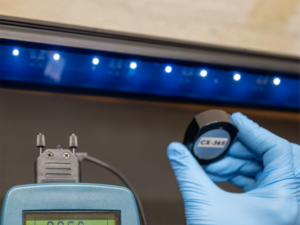
Exposure Limit Values – and why measurement matters
For UV radiation, the ELVs are derived from the guidelines of the International Commission on Non-Ionizing Radiation Protection (ICNIRP) and are expressed in terms of effective irradiance or radiant exposure, adjusted for the relative biological effectiveness of different UV wavelengths.
In plain terms, this means that the permissible daily dose of UV depends not just on the intensity of the source, but on its spectral output (how much energy it emits at each wavelength) and most importantly – how long and how closely a worker is exposed to it. Most employers do not have the specialist knowledge or equipment to evaluate this without specialist support.
This is why on-site UV measurement and assessment is such an important part of compliance. A proper assessment, carried out using calibrated instrumentation and following the right methodology provides objective evidence of whether exposure is within legal limits, and what action – if any, is required.
On-site UV measurement and assessment
Our specialist team will visit your site, evaluate your UV equipment and processes, measure personal UV exposure levels, and provide a clear written report with practical recommendations – giving you the evidence you need to demonstrate compliance.
The role of information and training
Even where engineering controls are well designed, the regulations are explicit: workers must be adequately informed about the hazards they face and trained in the safe use of UV equipment and the control measures in place. This is not simply a box-ticking exercise – it is a legal duty.
Effective UV safety training should cover: the nature of UV radiation and how it can harm the eyes and skin; the relevant Exposure Limit Values and what they mean in practice; the types of UV equipment in use and how to use them safely; the control measures and PPE available; and the importance of reporting any symptoms of overexposure.
Training should be provided to workers directly involved in UV processes, as well as others who may be in the vicinity of UV sources — maintenance personnel, cleaning staff, and others who might be inadvertently exposed. Records of training provided must be maintained.
For health and safety managers and those with responsibility for UV risk management, a deeper level of understanding is needed — one that goes beyond the basics and equips them to interpret risk assessments, evaluate control strategies, and take ownership of compliance on an ongoing basis.
UV Risk Management Training Course
Our specialist training course is designed for health and safety professionals and those responsible for UV processes. Monthly online group sessions are available, with private online or on-site delivery also an option. Includes course notes, a certificate of attendance, and an action plan template.
A practical approach to compliance
Achieving and maintaining compliance with the AOR Regulations does not need to be onerous – but it does need to be systematic. A sensible approach typically involves four stages: understanding the UV sources in your workplace; assessing the risk they pose to workers; implementing appropriate control measures; and ensuring workers are trained and informed.
For many organisations, particularly those introducing UV for the first time, or those who have expanded their use of UV technology without revisiting their risk management arrangements, there are often gaps – not because of negligence, but simply because the regulatory requirements are highly technical and the specialist knowledge required is not always readily available in-house.
We specialise in helping organisations get this right. With over 18 years of experience supplying UV equipment and supporting organisations across sectors including aerospace, automotive, electronics, food, healthcare and security, we understand both the technology and the regulatory landscape in depth.
How Arden Ultraviolet can help
- Free UV Safety Webinar – understand your legal obligations in a concise, practical session
- UV Risk Management Training – equip your health & safety team to own UV compliance
- On-site UV Measurement and Assessment – expert measurement, evidence-based reporting, clear recommendations
- Ongoing compliance support – process optimisation, reassessment, and employee training
- Equipment specification and supply – UV solutions optimised for safety and process performance
Whether you are encountering the AOR Regulations for the first time or looking to strengthen your existing arrangements, we would be happy to help. Contact us to discuss your requirements, or take the first step by joining one of our free UV safety webinars.